
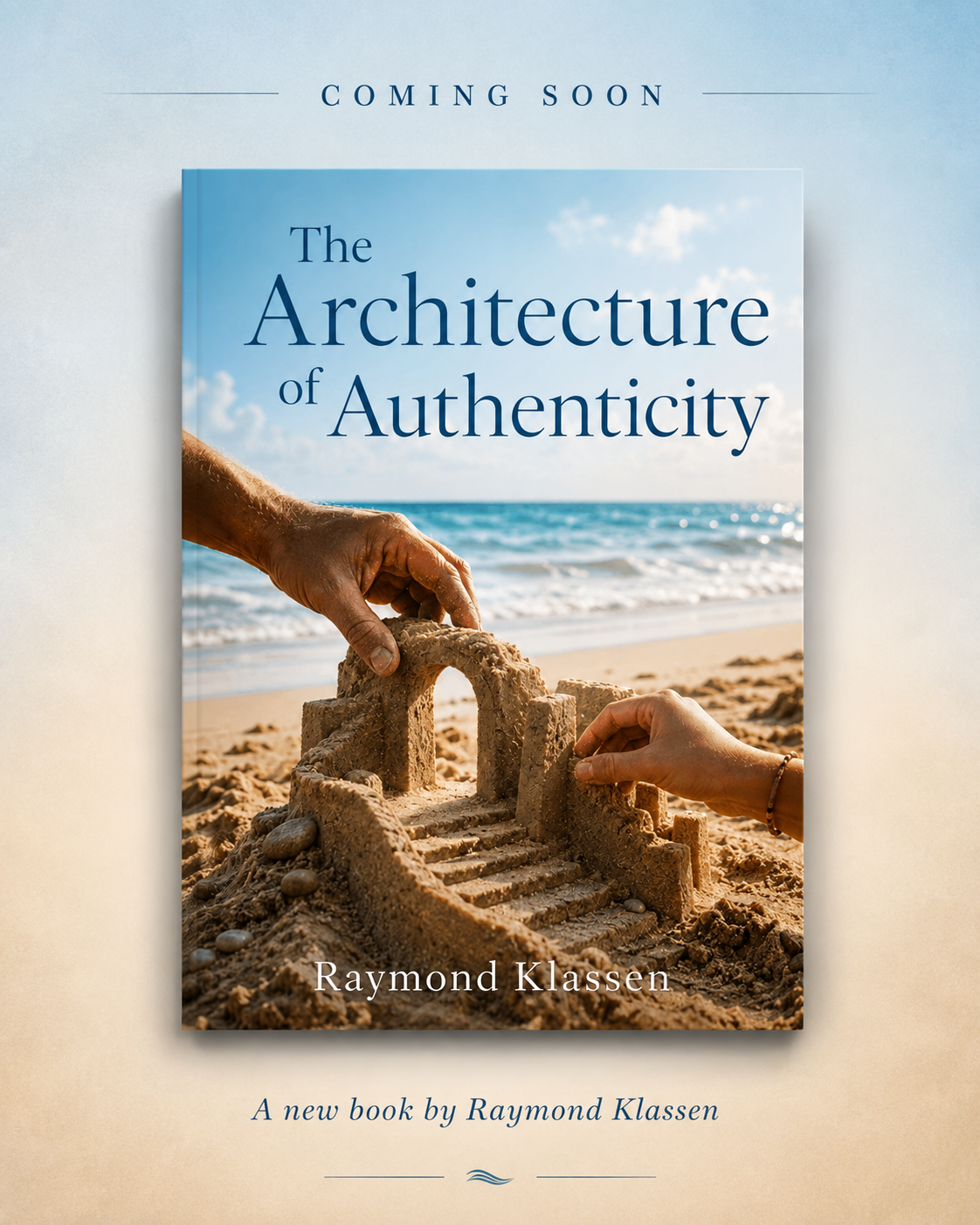
Cover concept: David Klassen Artist/Illustrator @ https://davidklassenfineart.com – used by permission.
“The Architecture of Authenticity is a rare book indeed: a heartfully reflective, rigorously attentive encouragement to reading wayfarers of modern life. The argument is fortified with philosophical depth, adorned with global perspective, and paved charitably with accessibility for the lay reader. Anyone who might summon the courage requisite to the vocation of “to thine own self be true” should read this book.”
– Dr. Joshua Harris, Associate Professor of Philosophy
Order the Architecture of Authenticity
“The Architecture of Authenticity offers a thoughtful, multifaceted framework for understanding the complex forces that shape our identity and the lives we build around it. Klassen’s thoughtful, multifaceted framework illuminates the interconnected dimensions of psychosocial development that impact how we understand ourselves, make meaning of our experiences, and navigate life’s choices. It is an invitation to understand authenticity not as a fixed destination, but as an evolving process of becoming.”
– Andrea Janzen, School Psychologist
The Architecture of Authenticity Preview:
The Architecture of Authenticity is a book about becoming a truthful self in a world that often pulls us away from ourselves.
Many of us live with a strange tension. We are constantly encouraged to “be ourselves,” express our identity, find our voice, and live authentically. And yet, the more often this language appears around us, the thinner it can begin to feel. Authenticity can become a brand, a mood, a performance, or a way of justifying whatever we already want. Meanwhile, many people feel scattered, anxious, overexposed, lonely, or unsure of how to hold their lives together.
This book begins in that tension. It does not reject authenticity. Instead, it asks whether authenticity has been misunderstood, reduced, and weakened. What if authenticity is not simply self-expression? What if it is not the freedom to invent ourselves without limits? What if becoming authentic is slower, deeper, and more demanding than simply “being true to yourself”?
The Architecture of Authenticity argues that authenticity is the formation of a truthful life. It involves honesty before the self, faithfulness in relationship, courage in public life, and receptivity before what we did not create. We become authentic not by escaping dependence, but by learning to receive our lives truthfully: our histories, our communities, our limits, our loves, our wounds, and our responsibilities.
The book unfolds through the major dimensions of human life. It begins with the private self, where immediacy, fragmentation, consumerism, and performance can leave us feeling divided within. It then turns to social life, where friendship, vulnerability, belonging, and community shape the kind of persons we become. It moves into political life, where truthful language, responsible power, and public courage become necessary for authentic agency. Finally, it enters spiritual life, where authenticity is revealed not as a possession we secure for ourselves, but as a gift we learn to receive and live.
At the heart of the book is a deeply human conviction: we do not become ourselves alone. We are spoken to before we speak. We are loved before we know how to love. We are formed by families, teachers, traditions, places, losses, friendships, and communities. The self is not a sealed room. It is more like a dwelling place slowly built through recognition, truthfulness, and grace.
The book draws from philosophy, literature, theology, education, and personal reflection. Charles Taylor and Hannah Arendt provide important anchors, but the argument also listens to spiritual writers, social critics, educators, Indigenous voices, and the ordinary experiences through which people come to understand their lives. Its concern is not only theoretical. It asks how we might live truthfully in a world that often rewards distraction, performance, conformity, and manipulation.
The spiritual claim of the book is gradual but central. Authenticity, rightly understood, may be one of the modern world’s deepest ways of naming the presence of grace in ordinary life. To become authentic is not to become self-sufficient. It is to become more honest, more receptive, more responsible, and more capable of love.
The Architecture of Authenticity is written for readers who still believe that “being yourself” matters, but who sense that the phrase must mean more than self-expression. It is for educators, seekers, believers, skeptics, and thoughtful readers who wonder whether the modern longing for authenticity might still be pointing toward something true.
This book says that it is.
“This is an insightful roadmap to achieving authenticity in our lives. Drawing on wisdom from various traditions and genres, the reader feels authenticity is possible by guiding the reader past the roadblocks on the way. Klassen lucidly articulates nuanced philosophical realities that are anything but abstract.”
– David Beck, Senior English Lecturer Emeritus
Order the Architecture of Authenticity
Reader Reviews:
“I found myself pausing to reflect on my own life.… That’s the mark of compelling philosophical writing.”
— Uchenna Mgbaja, Engineer, Educator, AI/Data Leader.
“The Architecture of Authenticity is a rare book indeed: a heartfully reflective, rigorously attentive encouragement to reading wayfarers of modern life. The argument is fortified with philosophical depth, adorned with global perspective, and paved charitably with accessibility for the lay reader. Anyone who might summon the courage requisite to the vocation of “to thine own self be true” should read this book.”
– Dr. Joshua Harris, Associate Professor of Philosophy
“It gave me words for lessons I had learned unconsciously. Now the architecture is set. And I feel relief.”
– Titiksha Dua – scientifically trained professional and Certified Yoga Instructor.
“I’ve long been suspicious of ‘authenticity-talk’ as potentially steering us down dangerous paths or else disappearing in cloud of meaningless verbiage. But Raymond Klassen, in this deep but very accessible book, has persuaded me that – done right – concern for authenticity is not only respectable but essential for navigating modern life.”
– Dr. Michael DeMoor, Associate Professor of Social Philosophy
“Living across cultures and languages, I identified with the quiet struggle this book names: how to adapt without losing ourselves.”
– M. Cristina Alé – Human Rights Lawyer and PhD researcher
“This is an insightful roadmap to achieving authenticity in our lives. Drawing on wisdom from various traditions and genres, the reader feels authenticity is possible by guiding the reader past the roadblocks on the way. Klassen lucidly articulates nuanced philosophical realities that are anything but abstract.”
– David Beck, Senior English Lecturer Emeritus
“The Architecture of Authenticity offers a thoughtful, multifaceted framework for understanding the complex forces that shape our identity and the lives we build around it. Klassen’s thoughtful, multifaceted framework illuminates the interconnected dimensions of psychosocial development that impact how we understand ourselves, make meaning of our experiences, and navigate life’s choices. It is an invitation to understand authenticity not as a fixed destination, but as an evolving process of becoming.”
– Andrea Janzen, School Psychologist
“A fresh and meaningful contribution, not a repackaging of familiar self-help ideas. It is serious, humane and distinctive, with lived material that makes the philosophy trustworthy,”
—GoDevico Publishing Editorial Team