
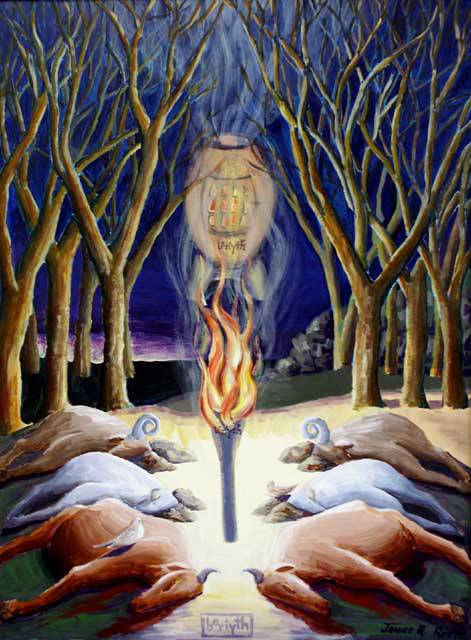
“For we live by faith, not by sight.” (2 Corinthians 5:7)
“The righteous man shall live by his faith.” Chabakuk 2:4
“And your Lord has said, ‘Call upon Me, and I shall respond to you.’” (40:60) Ghafir
If we were to look these days at what it’s like to live as a Palestinian in Gaza, or even the West Bank, surviving might only be possible by faith. At every place in Gaza, after all, there will soon be nothing to see. It will be wiped out. In every place in the West Bank, what were the Palestinians’ are now being annexed to the Israeli state. ‘Nothing to see, here! We walk by faith.’
It is the language of this world that in order to express empathy to the Palestinians, one must first condemn the attack by Hamas on southern Israel. In order to respond with empathy to the Israelis, one must first admit that the Israeli people are occupiers. In other words, to have a voice in the situation, one can only enter through the door of praise and blame. Dr. Norm Finklestein, the controversial Jewish-American political scientist committed to uncovering academic hoaxes, addresses this thorny issue in a recent podcast appearance. The challenge, if a person really considers it, of course, is that making moral judgments is really difficult – especially in as complex an issue as the relationship of the Palestinians and the Israelis. One could be confident in the facts, logic, and reason; but not in a moral judgment which can be spoiled by intuition – intuitions which any and all persons have in equal amounts. One is not particularly privileged morally because they happen to be advanced academically. No amount of education or expertise gives one more moral authority, only a gradation in the amounts of fact one has access to or in how sound one’s logic is. But moral judgments seem to be necessary, and every individual has the ability to make them – though some may want to opt out of the responsibility. A doctor, or a politician, or an eye witness cannot make moral judgments for bystanders.
As we have come to experience, certain moral judgments need to be proclaimed in order to sit down at the table of discussion in certain circles. An outright condemnation or statement of support for Israelis or Arabs are the extreme versions of this. As outrageous as this might seem to be, it is an issue with practical consequences. In Germany, for example, a draft law that binds the right to German naturalization to be contingent on affirming the right of Israel to exist will be put to vote on Friday, November 17, 2023. CNN political commentator, Van Jones was booed for supporting a ceasefire at a protest supporting Israel in Washington.
However, the necessity to express moral judgment of both Hamas’s attack on Oct. 7 and/or the massive U.S.-supported Israeli military response in order to even be allowed in the discussion seems beyond the distant observers (i.e., those who consume the events filtered by legacy and social media). Why do these observers seem to the least equipped to make moral judgments well?
Abraham’s Faith Credited as Righteousness
The problem is that the moral life is not made possible by sight, but instead, is made by faith. While facts are observed with our eyes and our ears, i.e. by sight, the faith which brings righteousness (Genesis 15:6) happens in relationship. For those that don’t know, Abraham is considered the father of three major religions: Christianity, Islam, and Judaism. In all three religions, Abraham’s faith (trust in the living presence of God) is considered his righteousness (moral justification) in Genesis 15, which is written about the Covenant between God and Abraham. But what or whom is the faith in? Some may think it is faith in the promise God makes to give the land in question to Abraham’s people. Most commentators think Abraham’s faith is in God (Yahweh). To be clear, Abraham’s faith is an unshakable trusting relationship with God.
If we are to engage in an authentic moral life in the Palestinian and Israeli situation we could safely describe as morally challenging, then it will have to be by faith, and not by sight; we might have a hard time believing moral descriptions in the media, because they are often instances of organized lying. Living by faith requires a direct and unprivileged connection with the other.
Examples of “Living by Faith” in the context of 2023 Palestine / Israel.
Bassam Yousef and Piers Morgan
In one of the most interesting media events that has happened since October 7 has been the building of faith in two separate interviews between the TV host Piers Morgan and the Egyptian satirist Bassam Yousef. In the first, Morgan was clearly asking Yousef Israeli-informed questions, asking for condemnations of Hamas’s attack before asking more in-depth questions. Clearly Morgan was asking for a blanket condemnation from Yousef before going more in depth. This interview, however, emboldened all those people who supported the Palestinians because of Yousef’s intelligent way of dealing with these questions – he satirized them to show that this way of communicating was indeed counter-productive. He showed that there was a better way of asking the questions – and frequently by satirizing the barrier between the bystander relationship and the relationship of faith. In the second, they have a longer where faith between them has been established. The second conversation, held in good faith, is a much more nuanced and fully intelligible effort to understand what is really going on. Breaking the bounds of a short time segment in the first, the second interview is long and exploratory. In the first, Yousef is sitting isolated in a studio without the ability to see Morgan; in the second, they sat face-to-face. In the first, Yousef is forced into satire; in the second, they speak directly with each other and with candor, honesty, and integrity.
This change exemplifies one aspect of living by faith: living by faith requires being patient, kind, and exploratory, and doesn’t know all the answers from the outset. Living by faith is to be filled with more questions than answers, and if there are answers, they are worked out between the parties.
Vivian Silver
Mrs. Vivian Silver, born in Canada, was killed in the October 7 attack. Ethnically and religiously Jewish, she lived in southern Israel for 50 years working for peace between Israelis and Palestinians. She was the head of peace organizations, and had worked on the ground providing jobs to Palestinians from Gaza.
She had taught three lectures in a class I had taken called “Conflict Resolution” at Menno Simons College at the University of Winnipeg in the early 1990s. Vivian had been born in Winnipeg. Although I wasn’t connected with her well, I was quite saddened by her loss; I lost a teacher. The world lost a person living and working for peace.
When she died, she was honored by all Canadian national news broadcasters, and several international ones as well. The common thread? She worked at the ground level for peace. And the thing that infuriated her greatly was that long before Hamas, Israelis had been saying that there was no other partner for peace with the Palestinians. It upset her because it was a stereotype used by people who had not worked with Palestinians, who had been neither to Gaza nor the West Bank. It was a stereotype.
Vivian demonstrated what it means to live by faith: it is a common project done by people willing to get their hands dirty with others. I remember a phrase a former pastor of mine once preached: “In order to help the poor, one must be willing to become poor.”
Ramsey Hahan (https://ramsey-hanhan.medium.com/)
Ramsey is a new friend of mine and is Palestinian, from Ramallah in the West Bank. We had interacted briefly in the early days of Al Aqsa flood. He wrote about problems that he saw with his eyes and heard with his ears. He shared with me some of the violent and cruel actions of some West Bank settlers with IDF support conducted towards Palestinian people and their land. On Oct. 12th, his social media accounts were shut down, and I heard from others that he was imprisoned because of his writing. His writing was one source of information for my English students about what was really happening in Palestine, and why our attention should not be myopically focused on Gaza. It was his instinct that the Israeli government’s long game is the West Bank. He might be correct about that.
He lives lives by faith because he has been writing the truth in Christian love. He truly loved his enemies – in spite of the fact that the IDF occupied his mother’s house and expelled her. He is part of my inspiration now to use my voice to build peace, and to also love my enemies. Sometimes, living by faith requires that we might die for our faith. I pray that he is not dead yet, and that he is only imprisoned or in hiding. Israel and Palestine would have certainly lost a partner for peace. And the faith we live by, as Ramsey has demonstrated, that the real enemy in this situation may very well be the action of trying to build peace between the two people on one land.
Ms. Faith
Faith is the name I am using for my new Palestinian American friend, who lived much of her childhood in the West Bank near Jerusalem. She now lives in California and expresses a deep desire to return to the West Bank. Faith has been giving me interviews and I will have the great opportunity to voice her story in the near future.
She is afraid to speak out because of the potential risk of her losing her finance job in the United States. Her story will be instigated by this ironic presence in the land of freedom, where she is credibly under coercion. To me, she lives by faith: faith in the possibility of peace, faith in me as her interviewer, faith in her friend, and faith in her mother, and faith in the beautiful land and culture of her childhood. She described such a land as a beautiful place where people could sleep with their doors unlocked and where everyone knew everyone else, and where no one was worried about theft, where no one was armed, and where random acts of violence were not part of her experience as they are now.
So different than America now… but a place I think we all can strive for, by faith.
Conclusion
If we remember the exhortation of the scriptural verses above, then making moral judgments will likely not be our first priority, although they will still be needed. Instead, we need to prioritize living and working together peacefully. We will need to see that each and every person – even the terrorists – were made in God’s image. We will need to live by faith: in doing so, we become righteous. We are not made holy by believing and asserting morality. It is a practice, and it is practiced peacefully. I pray that all people in this situation starts seeing God in the other, and the best way to live in future peace is to be peaceful now.

 Raymond Klassen - Ideals and Identities
Leave a comment