
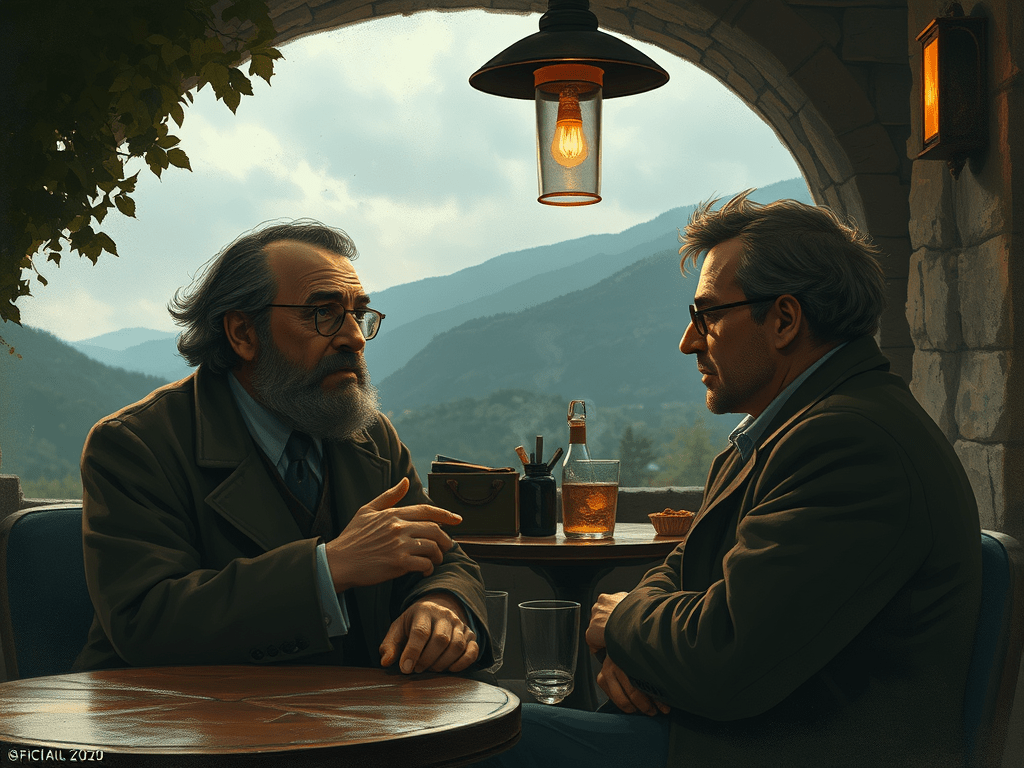
Setting
Late afternoon, early autumn, 1940—though time is porous here.
On the misty border between France and Spain, in a small stone café nestled in the foothills of the Pyrenees, two men sit beneath an overcast sky. One—slight, bearded, worn by exile—is Walter Benjamin, his coat folded neatly beside him. His eyes, dark and distant, scan the horizon with a mix of yearning and despair. Across the table sits Marshall McLuhan, younger, Canadian, a cigarette dangling playfully from his fingers and a glint of mischief in his eye.
A war rages in Europe. Fascism creeps across borders and minds alike. But the conversation unfolding between these two men is not about tanks or tyrants. It is about thought. About meaning. And about the shadowy power of a new kind of machine.
McLuhan:
Ah, Walter. We find ourselves in curious times—again. Just as your age wrestled with photography and cinema, ours has birthed something stranger: artificial intelligence. The machine does not merely replicate images now. It replicates thought.
Benjamin:
Indeed, Marshall. But I wonder—does it truly think, or does it merely echo? When the camera displaced the painter, the aura of the artwork began to wither. Now, it seems, the aura of the human mind itself is at stake.
McLuhan:
You’re still loyal to the aura, I see. The “unique presence in time and space.” But time and space have collapsed. With AI, we’ve passed into a new environment where cognition is no longer private, but a shared interface.
Benjamin:
And what is lost in that interface? With every reproduction, something is detached. The writer disappears from the text, the thinker from the thought. The ritual of thinking is replaced by the convenience of prompting.
McLuhan:
But this isn’t just erosion—it’s transformation. Every medium reshapes consciousness. The printing press intensified linearity. Radio compressed space. AI externalizes cognition. It makes the environment itself intelligent. The danger is not imitation, but that it replaces the conditions of perception.
Benjamin:
Yet to replace perception is to reshape identity. When a poem is written by a machine, it may be moving, even beautiful—but it lacks the biographical and historical situatedness that grounded human expression. It becomes detached from struggle.
McLuhan:
So? Literacy detached voice from body. The book detached speech from space. Simulation is not new. What troubles us is not AI’s difference from us—but its eerie sameness.
Benjamin:
That sameness is hollow. AI does not live. It remembers nothing. It knows only pattern. It cannot give birth to meaning—it merely recombines. Authenticity is not appearance; it is presence.
[A gust of wind rattles the café window. Benjamin adjusts his scarf. McLuhan smirks faintly and taps his cigarette against the saucer.]
McLuhan:
The medium is still the message, Walter. The message of AI is not what it says, but how it uses us. The student no longer learns to write—he learns to prompt. The scholar curates, rather than creates. Identity shifts from authorship to supervision.
Benjamin:
And so we lose something sacred. I warned of the aestheticization of politics. Now, we see the aestheticization of thought: insight without friction. It flatters the eye and bypasses the soul.
McLuhan:
Or perhaps it offers new ways to touch thought. Tools have always been extensions of the self. But AI—yes—it becomes the self’s environment. That’s the risk. It’s not a tool. It’s a habitat.
Benjamin:
Then let us be honest: we are becoming creatures of simulation. The aura is gone not just from art, but from thinking itself. The mind is no longer situated in time and struggle, but in stream.
Benjamin:
This, to me, is the heart of the matter. Without presence, there is no memory. Without struggle, no ethics. Can a civilization survive on imitation alone?
McLuhan:
That is the question. Not whether AI is “human”—but whether we remain human, surrounded by its reflections.
Benjamin:
And so, what is to be done?
McLuhan:
We must first become aware. Understand that AI is not just software—it is a medium. The message is us. What it reshapes is not only our knowledge, but our knowing.
Benjamin:
And we must reclaim presence. Not as nostalgia, but as ethical trace. Real thought leaves a fingerprint—of care, contradiction, cost.
McLuhan:
If we are wise, we won’t use AI to escape ourselves—but to rediscover ourselves.
The wind stills. A single crow cries from a distant tower. McLuhan lights another cigarette. Benjamin lowers his head for a moment, eyes closed. Somewhere—beyond the Pyrenees, beyond time—a server hums quietly. A prompt is typed. A response begins to form.

 Raymond Klassen - Ideals and Identities
Leave a comment