

The initial disorientation when you enter an entirely new country, with language barriers and unusual customs, can be frustrating. One experiences the space between not knowing and knowing. Yesterday, I came back to my home in Edmonton, Canada from a 5-day holiday in Puerto Vallarta, Mexico. When we got to Mexico, the immigration line-up was crowded and filled with Americans and Canadians who were ready to give advice to make it more “customer friendly.” The lower ceilings were, to me, symbolic of how limited the consumer mentality is – and the congestion of the room seemed to be a natural consequence of the way a “Christmas vacation on the beach” has been framed.
The frustration mounted when, once we were through immigration, our promised car reservation was left unfilled. We had paid for a car that just wasn’t there. The ensuing ride to our reserved apartment dropped us off with luggage 500 meters away from the place we had stayed.
This experience over 2 hours was frustrating and unpleasant, and my spouse responded in almost existential terror – especially when we had to rely on the kindness of a stranger to help us to get to our residence, which was located in a remote and wealthy suburb. “Where are we going to sleep tonight?!” And when we finally got to our place, the fridge was empty, and the sun was setting. “What are we going to eat?!” The only place to get food that was within walking distance was a gas station that sold a few snacks. The walk in the dark across the busy highway, where we walked shoulder-to-shoulder with cattle, brought out our more animal instincts, and the accompanying existential reality. At least there were instant noodles and pre-packaged donuts for breakfast.
I was reminded of my first days of living abroad, when I arrived in South Korea. A part of me was re-awakened, and it was better than any consumer experience. We were welcomed back to life, and it certainly wasn’t customer friendly. Being customer friendly definitely isn’t certainty.
On this same trip, I read Leo Tolstoy’s novella, The Death of Ivan Ilych. I recommend you read it… but since I know that most of you won’t: Leo Tolstoy’s The Death of Ivan Ilych follows the life and slow dying of a respected Russian judge who has carefully organized his existence around social propriety, professional success, and the pursuit of comfort. Ivan is diagnosed with a mysterious and fatal illness. Yet, the bourgeois habits that once sustained him, the most important for my considerations here is cultivated pleasantness, collapse under the weight of physical pain and existential terror. His friends and family retreat into the polite denial that he is very familiar with. Ivan is forced into radical isolation, where he confronts the possibility that his socially approved life has been spiritually empty and morally evasive. Through suffering, he begins to glimpse an alternative orientation to life grounded in compassion, honesty, and authentic relation to others. In the final moments, Ivan’s fear gives way to a release that resembles moral awakening, as death strips away illusion and reveals that the lifelong pursuit of comfort and pleasantness was less a love of happiness than a defense against the fear of facing the brutal truth of existence itself.
The next 3 days was an interesting balance between pursuing of comfort and pleasantness and going through the unpleasant efforts of getting it. For the first 3 days, getting out of the unquestionable pleasantness of the residence to get to the beach, or being out in the midday heat to visit artisanal markets were peppered with some screaming. From an outsider’s perspective Ivan Ilych’s last three days of his pleasant life was filled with agonizing screaming.
Yet, the last 2 days were a realization that we could find our own authentic groove. We rented ebikes, we lounged on the beach at sunset. We bought a chessboard. We played cards. We had a couple of beers. And we smiled at each other as I put lotion on her sunburnt shoulders. Once we faced the existential terror and went through it, we began to re-connect and enjoy life.
I wonder, has all the incredible enormity of our economy been simply the pursuit of pleasantness? I wonder, with Tolstoy, if this giant pursuit is simply an entire evasion of facing life?
When we got back to the airport in Puerto Vallarta yesterday, one serviceperson was waiting on more than 200 passengers who were anxious about not getting on their flight. We had arrived 2:45 before our flight. 45 minutes into our waiting time, the line-up of people began to applaud as 3 more service people showed up and made the line go quicker. But the picture of the line in my mind demonstrated the enormity of the fear.
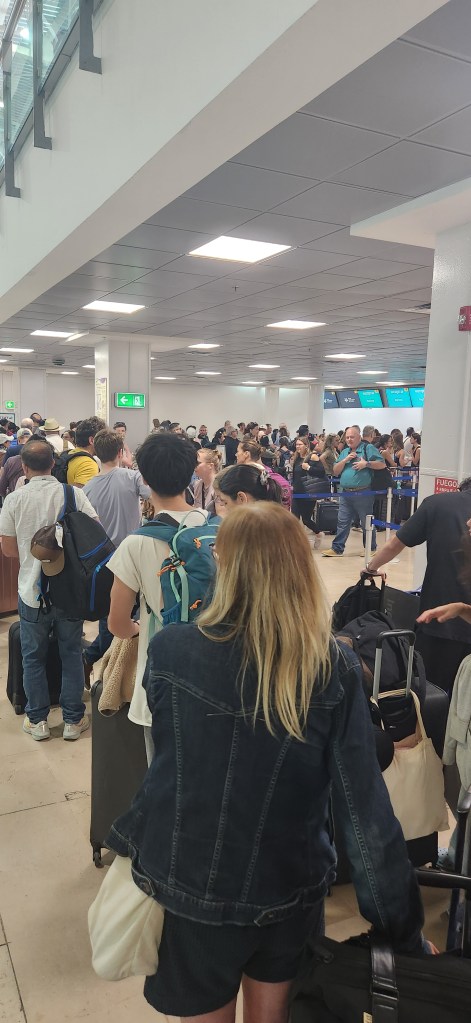
I asked the couple behind us, “Are you waiting for the flight to Edmonton?”
“Yes, we are on our way to Winnipeg.”
“How long is your layover?”
“3 hours. I hope we make it.”
“You’ll be just fine.”
“I am not sure.”
“Don’t worry. Edmonton is a small airport.”
But when everyone finally boarded, the passengers returned to their phones and tablets to play games, watch videos, doom scroll, and to distract themselves from yawning terror of 5 hours with their thoughts. “When are they going to serve beverages?! I wonder how many times I can get up to go to the lavatory to give me something to do?”
When we left Edmonton 5 days ago, it was -28. When we returned, it was +1, but the snow had accumulated on our front walk and driveway. I was too tired to shovel it away at 7:30 pm, in the dark, after a long travel day. But I look outside now, in the midday light of New Year’s Eve with the energy to dig through it so we can go for a walk, and take out our garbage, and let the cats out.
On the Canadian prairies, we battle the cold for 3 to 4 (sometimes 5) months every year. And I know we need a break sometimes, especially as we get older. But sometimes I wonder if the pursuit of pleasantness and comfort has this dark underside the masses are avoiding. It never goes away. The elephant is always in the room, and we decorate our rooms to avoid addressing it.


 Raymond Klassen - Ideals and Identities
Leave a comment