
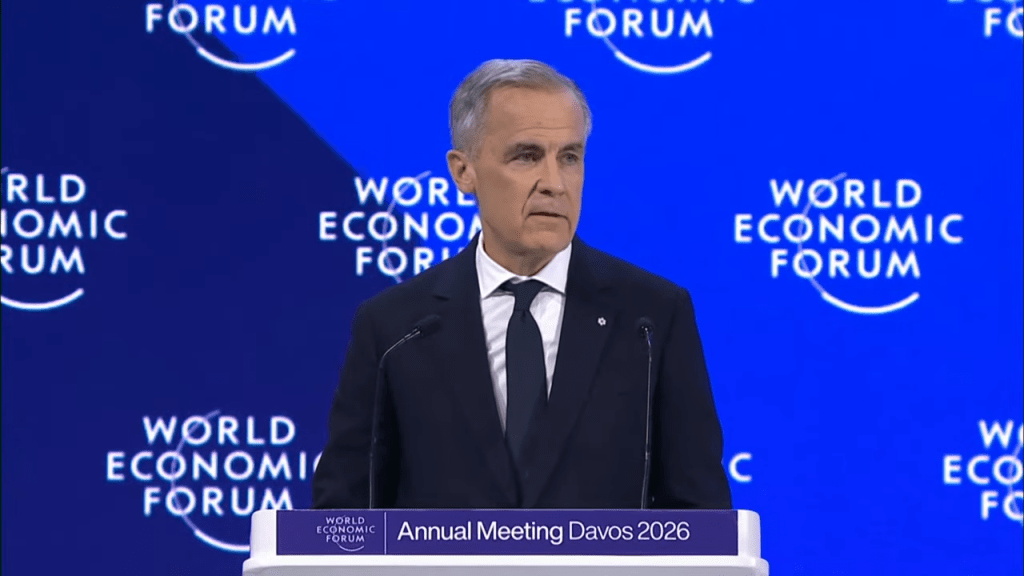
In Davos, Switzerland, at the World Economic Forum, Canadian Prime Minister Mark Carney invited us to buy a story today. He also invited us to buy a dichotomy. Our answer to both invitations can be formative to how a person, or nation, goes forward. We might again be reminded of being mindful in the face of the noise of autocracy on our borders.
First, the dichotomy: one way of living is in partnership with others; another way of living is acting unilaterally, and individually, that translates as acting autonomously. But I have a question: which one do you believe is the best way to act? Is it even an either-or choice? Or do we vacillate between autonomy and cooperation? What do you think?
Second, Carney tells a story that we should buy:
For decades, countries such as Canada prospered under what was described as the rules-based international order. They joined its institutions, praised its principles, and benefited from its predictability. This system made possible the pursuit of values-based foreign policy under its protection. Yet there was always an awareness that the story was only partially true. Powerful states exempted themselves when it suited them. Trade rules were enforced asymmetrically, and international law was applied with varying rigor depending on the identity of the accused or the victim (Ikenberry, 2011).
Nevertheless, this fiction proved useful. American hegemony, in particular, supplied public goods: open sea lanes, a stable financial system, collective security, and frameworks for resolving disputes (Kindleberger, 1973). As a result, many states placed the metaphorical sign in the window, participated in the rituals, and avoided calling out the discrepancy between rhetoric and reality. This bargain, however, no longer holds.
The present moment constitutes not a transition but a rupture. Over recent decades, crises in finance, health, energy, and geopolitics have exposed the risks of extreme global integration (Rodrik, 2011). More recently still, great powers have begun to weaponize that integration. Tariffs are used as leverage, financial infrastructure as coercion, and supply chains as vulnerabilities to be exploited (Farrell & Newman, 2019). Under such conditions, it is no longer possible to live within the lie of mutual benefit when integration itself becomes a source of subordination.
In short, the rules-based international order worked so long as it was supported by American hegemony, yet, it has not been evenly applied. It allowed, according to Carney, to pursue values-based international policy, but it has also been a source of injustice, especially when international integration is the focus of order. In other words, “rules-based international order” is not an unqualified good. Powerful states can exempt themselves from such an order. And they can be used to subordinate one partner to the other through “leverage” points. We may be very familiar with this with all the talk of tariffs.
The complete text of his talk is below, but I want to highlight two important assumptions. The powerful states that seem to act autonomously – and our minds might jump to USA, China, and Russia – are playing zero-sum games. That is, their benefit is another country’s loss. And the cooperative states (the middle powers that Carney counts Canada among) are playing games where the sum total of benefits of cooperation are greater than the inputs of the cooperation. In effect, he is asking whether there are two different games that countries are playing, and he seems to think so. The implication is that NATO should continue playing the latter game, but now minus the support of American hegemony.
At a time where the USA has invaded Venezuela and is threatening to invade Greenland, and where China threatens Taiwan, where Russia has invaded Ukraine, and many are aiming for Arctic security, this may be prudent – at least to respond to immanent catastrophe. However, I wonder if we are not smuggling in an assumption that cannot hold in the long run.
After all, the zero-sum autocracies have all eventually fallen, if we believe history. Wouldn’t the same thing happen in the end? Don’t all dictators get dragged, kicking and screaming, to their own demise?
The second assumption is, I think, far more pernicious. It is whether or not a rules-based international order of cooperative nations is the neutral basis of values-based international policy. Carney asks us to buy this dubious hierarchy. It echoes with a cynicism of the very existence of human rights as the inalienable possession of sovereign nations that acts as a grounding to living out our values.
But we may want to question that. We may, in fact, create and sustain rules that foster cooperation, nurture sovereignty, and build relational networks: rules that sanction disaffiliation of any individual states, and that incentivize positive-sum relations. And if we do that, perhaps, then, it isn’t the rules that enable values; it will be the values that inform the rules. We may even understand that a mutual sovereignty undergirds any possibility of existence.
Greenland looks like it will be an international testing ground. Minneapolis looks like the domestic testing ground.
And, for Mark Carney’s speech (I have generated a title):
Living the Truth in a World of Rupture: The Role of Middle Powers (by Canadian Prime Minister Mark Carney at the World Economic Forum, January 20, 2026)
The contemporary international system increasingly appears submitted to no limits and no constraints. Yet this condition does not imply that all states are powerless. On the contrary, intermediate or middle powers, such as Canada, retain the capacity to help construct a new international order grounded in shared values, including respect for human rights, sustainable development, solidarity, sovereignty, and the territorial integrity of states. The power of the less powerful, however, must begin with honesty.
We are repeatedly reminded that we live in an era of great-power rivalry. The rules-based international order is widely perceived to be fading, while the old aphorism attributed to Thucydides—that the strong do what they can and the weak suffer what they must—is frequently invoked as the natural logic of international relations reasserting itself (Thucydides, trans. 1996). Faced with this logic, many countries are tempted to accommodate, to comply, and to hope that submission will purchase safety. Yet such compliance does not, in fact, provide security.
To understand the available alternatives, it is useful to return to Václav Havel’s (1978) essay, “The Power of the Powerless.” Havel asked how the communist system managed to sustain itself. His answer centered on the figure of a green grocer who each morning placed a sign in his shop window reading, “Workers of the world, unite.” The shopkeeper did not believe the slogan, nor did his customers. He displayed it in order to avoid trouble and to signal compliance. Because every shopkeeper on every street performed the same ritual, the system endured—not solely through violence, but through the participation of ordinary people in practices they privately knew to be false. Havel described this condition as “living within a lie.” The system’s power derived not from truth, but from universal performance, and its fragility lay in the same source.
For decades, countries such as Canada prospered under what was described as the rules-based international order. They joined its institutions, praised its principles, and benefited from its predictability. This system made possible the pursuit of values-based foreign policy under its protection. Yet there was always an awareness that the story was only partially true. Powerful states exempted themselves when it suited them. Trade rules were enforced asymmetrically, and international law was applied with varying rigor depending on the identity of the accused or the victim (Ikenberry, 2011).
Nevertheless, this fiction proved useful. American hegemony, in particular, supplied public goods: open sea lanes, a stable financial system, collective security, and frameworks for resolving disputes (Kindleberger, 1973). As a result, many states placed the metaphorical sign in the window, participated in the rituals, and avoided calling out the discrepancy between rhetoric and reality. This bargain, however, no longer holds.
The present moment constitutes not a transition but a rupture. Over recent decades, crises in finance, health, energy, and geopolitics have exposed the risks of extreme global integration (Rodrik, 2011). More recently still, great powers have begun to weaponize that integration. Tariffs are used as leverage, financial infrastructure as coercion, and supply chains as vulnerabilities to be exploited (Farrell & Newman, 2019). Under such conditions, it is no longer possible to live within the lie of mutual benefit when integration itself becomes a source of subordination.
As a consequence, the multilateral institutions upon which middle powers have relied—including the WTO, the United Nations, and climate governance frameworks—are increasingly under strain. Many states have concluded that they must develop greater strategic autonomy in energy, food, critical minerals, finance, and supply chains. This impulse is understandable: a country that cannot feed itself, fuel itself, or defend itself has few meaningful options. When rules no longer provide protection, self-protection becomes necessary (Posen, 2014).
Yet a world composed entirely of fortresses would be poorer, more fragile, and less sustainable. Moreover, if great powers abandon even the pretense of shared rules and values in favor of unrestrained pursuit of interest, the gains of transactionalism will diminish. Hegemons cannot indefinitely monetize their relationships. Allies will diversify, hedge against uncertainty, and seek to rebuild sovereignty—sovereignty no longer grounded primarily in rules, but increasingly anchored in the capacity to withstand pressure (Krasner, 1999).
This development reflects classic risk management. While risk management carries costs, those costs need not be borne individually. Collective investments in resilience are less expensive than universal isolation. Shared standards reduce fragmentation, and complementarities can generate positive-sum outcomes (Keohane & Nye, 2012). The central question for middle powers is therefore not whether adaptation is required, but whether adaptation will take the form of higher walls or more ambitious cooperation.
Canada’s response has been to pursue what has been described as values-based realism. This approach combines principled commitments—to sovereignty, territorial integrity, human rights, and the prohibition of force except under the UN Charter—with pragmatic recognition that interests diverge and progress is often incremental. It involves engaging the world as it is, calibrating relationships so that their depth reflects shared values, and broadening engagement in order to maximize influence in an uncertain environment.
Living the truth, in this context, requires naming reality. It requires ceasing to invoke the rules-based international order as though it still functions as advertised, applying standards consistently to allies and rivals, and building institutions that operate as described. It also requires reducing the leverage that enables coercion through strong domestic economies and international diversification. Such diversification is not merely economic prudence; it is the material foundation of an honest foreign policy (Havel, 1978).
The old order is not returning, and nostalgia offers no viable strategy. From rupture, however, middle powers can build something more resilient, more just, and more sustainable. This task demands honesty about the world as it is, strength at home, and collective action abroad. It is through this path that middle powers can refuse to live within a lie and instead help shape a new international reality.
References
- Farrell, H., & Newman, A. L. (2019). Weaponized interdependence: How global economic networks shape state coercion. *International Security, 44*(1), 42–79.
- Havel, V. (1978). *The power of the powerless*. Prague: samizdat.
- Ikenberry, G. J. (2011). *Liberal Leviathan: The origins, crisis, and transformation of the American world order*. Princeton University Press.
- Keohane, R. O., & Nye, J. S. (2012). *Power and interdependence* (4th ed.). Longman.
- Kindleberger, C. P. (1973). *The world in depression, 1929–1939*. University of California Press.
- Krasner, S. D. (1999). *Sovereignty: Organized hypocrisy*. Princeton University Press.
- Posen, B. R. (2014). *Restraint: A new foundation for U.S. grand strategy*. Cornell University Press.
- Rodrik, D. (2011). *The globalization paradox*. W. W. Norton & Company.
- Thucydides. (1996). *History of the Peloponnesian War* (R. Warner, Trans.). Penguin Classics.

 Raymond Klassen - Ideals and Identities
Leave a comment