
When I was in my twenties, I was seeking to demonstrate to any and all of my familial and social connections that I was in control of my life. I exercised autonomy; I was a good person; I could manage anything and everything I encountered.
It was a tragic outlook. I lost jobs; I lost my marriage. I fought hard to control the stories about myself and my actions. I fought hard to hide the actions which I knew were the most shameful.
Significant others stepped in to sharpen me up to a reality I failed to acknowledge: the people who cared most for me, i.e., those who held space for me relationally and who were crucial to my own identity, would not tolerate my instinct to “go it alone.”
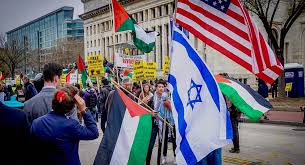
Donald Trump, Benjamin Netanyahu, and “the greater Israel Project” remind me of me in my twenties.
When wars begin, the struggle that unfolds is not only military. It is also narrative. Governments understand that public support for war depends on more than battlefield success. It depends on whether citizens believe the war is morally justified. For this reason, political leaders devote enormous energy to defining how a conflict should be understood.
The first battle in many wars is therefore a battle over framing. Leaders attempt to shape the moral question the public believes it must answer. If they succeed, they gain a powerful advantage. People do not simply react to events. They react to the story that explains those events.
The Iraq War in 2003 offers a clear example. The United States government framed the conflict around the threat of weapons of mass destruction. Officials argued that Saddam Hussein’s regime either possessed such weapons or was close to acquiring them. The implication was that waiting could be disastrous. If a hostile government obtained devastating weapons, the consequences could be catastrophic.
By presenting the situation this way, the moral question facing the public became one of precaution. What if the threat were real and the world failed to act in time? Within that narrative, military action appeared not reckless but responsible. Critics of the war attempted to challenge this framing by emphasizing uncertainty in the intelligence and the importance of international law. Their argument encouraged the public to consider a different question: should a nation launch a war based on unproven claims about future dangers?
Both sides were discussing Iraq, but they were asking fundamentally different moral questions. The debate that followed was as much about narrative as it was about evidence.
A similar contest over framing emerged during Russia’s invasion of Ukraine. Western governments described the war as a clear case of territorial aggression. A sovereign state had been invaded and its territory threatened. When the conflict is described this way, the moral response seems obvious. If territorial conquest is tolerated, the stability of the international system collapses.
Russia presented a different narrative to its own citizens and to sympathetic audiences abroad. Russian leaders argued that NATO expansion threatened their country’s security and that Ukraine had become a platform for hostile influence. Within this narrative the war was not aggression but defense against encirclement. The moral question therefore shifted. Instead of asking whether borders should be protected, audiences were asked whether a great power has the right to defend its security interests in its own region.
The events on the ground were the same, yet the moral interpretation changed dramatically depending on which narrative one accepted.
The conflict between Israel and Hamas also illustrates how framing can evolve during a war. The initial attacks carried out by Hamas against Israeli civilians generated global outrage. In that moment the dominant narrative centered on terrorism and the right of a country to defend itself. Many governments expressed solidarity with Israel because the moral question appeared clear. What nation would tolerate such violence against its citizens?
As the war continued, however, the narrative landscape shifted. Images of destruction and humanitarian suffering in Gaza circulated around the world. Critics of Israel’s campaign reframed the conflict around civilian protection and the limits of military force. The question many observers began asking was no longer simply about terrorism. It was about proportionality, humanitarian law, and the protection of noncombatants. The same war now appeared through two moral lenses at once.
The tensions involving Iran reveal another struggle over narrative framing. Those who advocate strong pressure on Iran emphasize regional security concerns. They point to Iran’s nuclear ambitions and its relationships with militant groups across the Middle East. Within this frame the moral question becomes whether the world should prevent a dangerous regime from expanding its power.
Iran and its supporters emphasize sovereignty and historical memory. They highlight decades of foreign intervention in the region and argue that powerful states routinely attempt to reshape governments they dislike. In this narrative the central question becomes whether military pressure or regime change should be acceptable tools of international politics.
These competing narratives show why framing matters so much in modern conflicts. A war described as self-defense feels morally different from a war described as aggression. A campaign framed as preventing catastrophe appears different from one framed as violating sovereignty.
Governments understand this dynamic and devote enormous effort to shaping the stories that accompany military action. Diplomatic speeches, press briefings, interviews, and social media messaging all contribute to the construction of a narrative that explains why a war is necessary.
In the modern media environment this struggle unfolds rapidly. Images and arguments circulate across the globe within minutes. Political leaders attempt to influence how these images are interpreted, while journalists, analysts, and citizens participate in the debate.
The result is a complex narrative battlefield that exists alongside the physical one. Military operations may take place thousands of kilometers away, but the struggle over meaning occurs everywhere. Public opinion, alliances, and diplomatic legitimacy all depend on how the conflict is understood.
For observers and citizens, recognizing this process is essential. Before reacting to a war, it is worth asking a simple question: what moral problem is this narrative encouraging me to solve? Every framing highlights certain facts and downplays others. It directs attention toward particular values while pushing alternative perspectives into the background.
Understanding framing does not mean abandoning moral judgment. It means becoming more aware of how that judgment is shaped. Instead of accepting the moral question presented by political leaders, thoughtful observers can step back and examine whether that question captures the full reality of the conflict.
Modern wars are therefore fought on two levels. There is the struggle over territory, weapons, and strategy. But there is also the struggle over meaning. Whoever defines the moral question often shapes the political outcome of the war.
Recognizing this dynamic gives citizens a measure of independence in a world of competing narratives. Rather than simply answering the question that governments place before them, they can ask a deeper one: why is this particular question being asked in the first place?
In my personal case, I was trying to uphold an image of myself. It seems that the US-Israeli adventure into Iran is plagued by the same pattern. All the while that they attack Iran in order to weaken and fragment Iran, the Israelis continue the process of annexing the West Bank. They try to elevate their particular interests to universal concern. But that is not possible. The so-called universal concern of a weaker Iran is not universal at all. The Gulf Coast countries (GCC) (the UAE, Saudi Arabia, Qatar, Bahrain, Kuwait, and Oman) do not necessarily seek a weak Iran. And taking on the project of a weak Iran in the name of the moral framing of the righteousness of “the Greater Israel project” is on the condition of guaranteed US-backed security over the region. This week, we now see that the US does not have the ability to fulfill this guarantee.
I eventually found out two lies in my personal narrative that framed my actions and the resulting conflicts: I was neither autonomous nor good.
My guess is that Israel and the United States will learn the same lesson – but their case, it will have global consequences.
More of my writing occasioned by the war between Israel-USA and Iran:
The QuestionS of Wars: Why Every War Asks the World Different Moral Questions

 Raymond Klassen - Ideals and Identities
Leave a comment