
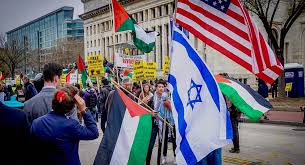
Iran stopped enriching weapons-grade uranium because it no longer needed to for its own security. There is a revealing phrase circulating in discussions of the current Israel–Iran confrontation: that closing the Strait of Hormuz would be Iran’s “nuclear option.” The phrase is meant metaphorically. And yet, like many metaphors, it reveals more than it intends.
It reveals that we are no longer thinking about escalation in purely military terms. It reveals that the structure of war itself has changed.
And most importantly, it reveals that Iran’s most powerful escalation is not destructive in a military sense; it is disruptive in a civilizational sense.
To understand why this matters, one must begin with the old grammar of escalation. During the Cold War, strategists imagined conflict as a ladder. At the bottom were symbolic gestures and limited strikes. Higher up were sustained campaigns, then attacks on infrastructure, and finally, at the very top, nuclear war. Each rung represented an increase in destructive capacity, culminating in the absolute horizon of annihilation.
But the Strait of Hormuz does not fit neatly on this ladder.
It does not threaten annihilation in the traditional sense. It does not incinerate cities. It does not produce the immediate spectacle of destruction that defined twentieth-century total war. Instead, it targets something more subtle and, in many ways, more foundational: the hidden architecture of global life.
Roughly one-fifth of the world’s oil and a significant portion of its natural gas pass through this narrow maritime corridor. To disrupt it is not simply to interrupt a supply chain. It is to interfere with the circulatory system of the modern world.
Energy is not merely a commodity. It is the condition of possibility for contemporary existence. It powers transportation, sustains food production, underwrites financial systems, and stabilizes political order. To choke this flow is to produce cascading effects across every layer of society.
And this is precisely what makes the metaphor of the “nuclear option” so revealing. What is being named is not the scale of destruction, but the scale of consequence.
In recent days, those consequences have begun to materialize. Oil prices have surged above $100 per barrel, raising fears of recession and inflation across major economies. Global trade is slowing, with key sectors from energy to agriculture already experiencing disruption. Fertilizer shipments are affected, transport networks strained, and the price of food itself is beginning to rise.
What emerges here is a different logic of power.
Israel, backed by the United States, operates largely within a traditional model of escalation. Its strength lies in precision, air superiority, and the capacity to degrade military and political targets. Its escalation is vertical: more force, more reach, more intensity.
Iran, by contrast, operates along a different axis. It cannot dominate at the highest levels of conventional or nuclear warfare. Instead, it escalates horizontally. It expands the field of conflict outward, transforming a regional war into a global problem. It places a moral question before Israelis and Americans: is your asserted national sovereignty what you thought it was? Does domination accurately express your national interests and identity?
Closing the Strait of Hormuz is the ultimate expression of this strategy. It does not defeat an enemy in battle. It compels the world to feel the war.
In this sense, the escalation ladder has fractured. There is no longer a single hierarchy of force, but multiple, overlapping systems of escalation. One side seeks to destroy. The other insists that we are already entangled.
This distinction matters because entanglement produces a different kind of danger. Destruction, however catastrophic, is often bounded. It occurs within identifiable targets and territories. Entanglement, by contrast, spreads. It propagates through networks, dependencies, and the fragile interconnections that define globalization.
The modern world is uniquely vulnerable to this form of disruption because it is uniquely integrated. Supply chains stretch across continents. Energy flows bind distant economies together. Financial systems react instantaneously to shocks in faraway regions. What appears as a localized conflict can, under the right conditions, become a global event.
This is why some analysts warn that a prolonged disruption of the Strait of Hormuz could trigger not merely a crisis, but a systemic breakdown. A sustained closure would remove a significant portion of global energy supply, driving inflation, contracting growth, and potentially tipping major economies into recession. As the satirical line puts it: “Come see the violence inherent in the system!”
In such a scenario, the line between war and non-war begins to dissolve.
There are no bombs falling on European or Asian cities, and yet their economies falter. There are no troops marching through distant capitals, and yet their political systems strain under rising prices and public unrest. The effects of conflict are no longer confined to the battlefield. They are diffused across the entire structure of global life.
This is what it means to speak of civilizational disruption.
It is not the destruction of civilization in the dramatic sense, but its destabilization in the systemic sense. It is the weakening of the underlying conditions that make ordinary life possible.
And here, the metaphor of the “nuclear option” returns with renewed significance. What nuclear weapons represented in the twentieth century was not simply destructive capacity, but deterrent capacity. They imposed limits on escalation by threatening consequences so vast that they could not be contained.
The closure of the Strait of Hormuz gestures toward a similar logic, but through different means. It suggests that in a world of deep interdependence, the most powerful weapon may not be the one that destroys the most, but the one that disrupts the most.
This points toward a transformation in the nature of deterrence itself. We are no longer dealing solely with mutually assured destruction. We are entering a world of mutually assured disruption. In such a world, the question is no longer who can inflict the greatest damage on an enemy, but who can impose the greatest strain on the systems that sustain global order.
And this is what makes the current escalation between Israel and Iran so dangerous. Each side is strongest at a different level of conflict. Each possesses a form of escalation that the other cannot easily counter.
Israel can escalate toward annihilation. Iran can escalate toward uncontainability.
Between these two logics lies a widening gap where miscalculation becomes increasingly likely. For when escalation is no longer shared, it becomes harder to predict. When the ladder is no longer linear, it becomes harder to climb down. And when war ceases to be contained, it ceases to remain regional.
Escalation becomes, instead, a test of the resilience of the systems upon which the modern world depends.
And that means a reconceptualization of what order is.
There is no off-ramp from sovereignty. Once political identity is organized around the claim to act from within oneself what I have elsewhere described as sovereignty’s deep appeal to authenticity it becomes exceedingly difficult to return to a “rules-based order” without experiencing it as submission. Sovereignty is not merely a legal status; it is an existential posture.
In my analysis of modern political discourse, sovereignty appears as a response to perceived loss of control. It promises a restoration of agency. But when sovereignty becomes sacralized, as in reflections on regime change, compromise begins to appear not as prudence but as betrayal. The political field becomes moralized. Escalation is no longer strategic; it is ethical and spiritual.
And once escalation becomes a spiritual struggle, it loses its limits.
The imagination of order shifts accordingly. No longer is the world understood as a system of mutual dependence, but as a field of competing, self-justifying sovereignties. Each actor must assert itself or risk dissolution. Each concession becomes a form of self-negation.
In such a world, there is no stable equilibrium. Only temporary pauses in a broader struggle for legitimacy.
This is where civilizational disruption reaches its deepest level. Systems break down. Moreover, the shared imagination that sustains those systems begins to erode. Trust in global order weakens. The expectation of continuity gives way to the expectation of crisis.
The Strait of Hormuz, in this sense, is more than a strategic chokepoint. It is a symbolic one. It reveals how fragile the structures of interdependence have always been. It exposes the tension between a globalized system and a political imagination still rooted in autonomous sovereignty.
What we are witnessing, then, is not simply an escalation between states. It is a transformation in the conditions of order itself. The danger is not only that the conflict expands, but that it becomes psychologically and spiritually uncontainable.
Israel can escalate toward annihilation. Iran can escalate toward uncontainability.

 Raymond Klassen - Ideals and Identities
Leave a comment