
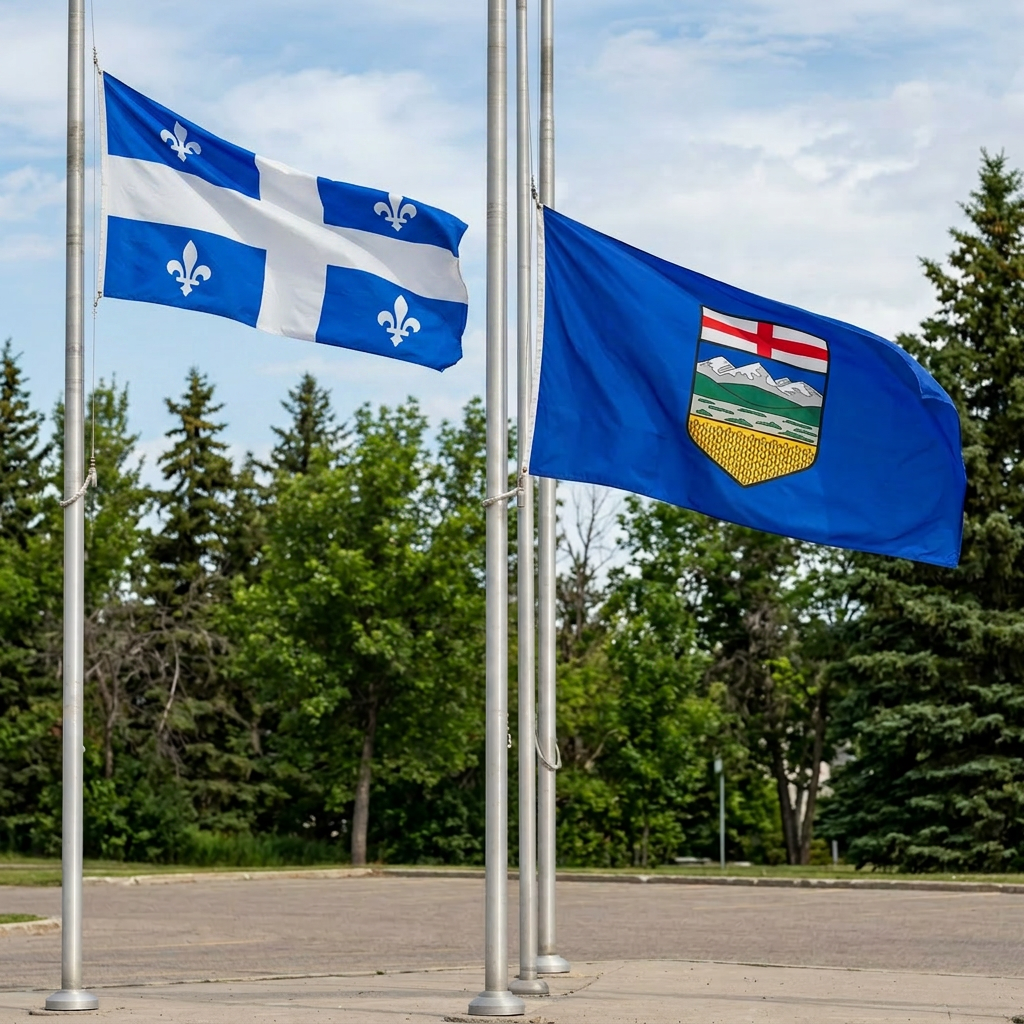
I first felt the pull of separatist language not in Alberta, but in Winnipeg. In the 1990s, I lived in St. Boniface, near St. Vital, within the French-speaking world of the city. Quebec’s referendum, and the arguments over sovereignty and association that surrounded it, did not feel to me then like a childish refusal of Canada. It felt like a serious argument about language, memory, peoplehood, and political recognition.
I did not have to agree with every part of the movement to understand why it carried moral weight. It seemed to arise from a community asking whether it could appear as itself within a larger political order.
The Alberta separatism I encountered after returning west in the twenty-first century felt different. Again, some grievances are real and should not be dismissed. Federalism becomes brittle when it cannot hear regional injury. But the emotional grammar was not the same. The Alberta version often felt less like a thick national-cultural claim and more like a desire to be free from interference, free from Ottawa, free from limits imposed by people imagined not to understand us.
At times, it had the feeling of a high school student wanting to escape his parents: understandable in its frustration, sometimes perceptive about real constraints, but not yet a mature account of freedom.
The comparison is imperfect, but it clarifies something important. Quebec sovereignty in the 1990s drew much of its force from language, culture, historical memory, and the desire for collective recognition. Even at the point of possible rupture, the language still carried the question of relationship. Alberta separatism, by contrast, often speaks in the register of release.
A people may seek recognition because it wants to appear more truthfully in the shared world. A province may also seek sovereignty because it has begun to imagine freedom as release from the shared world itself.
In that second form, separatism becomes radical individualism at political scale. The political community speaks like the isolated self: I am most free when least bound.
That is where authenticity becomes political.
Authenticity is often treated as a private concern. We imagine it as the work of finding one’s voice, becoming honest with oneself, resisting false expectations, or refusing to live according to someone else’s script. All of that matters. A person who cannot become inwardly truthful will struggle to act truthfully anywhere else.
But authenticity does not remain private for long.
Sooner or later, the question changes. It is no longer simply, Am I being true to myself? It becomes, Can I act truthfully in a world I share with others? That is where authenticity becomes political.
This is also where the language of freedom can become dangerous. In our culture, freedom is often imagined as release. I am free when no one interferes with me. I am free when no one corrects me. I am free when no institution, community, government, tradition, or relationship can make a claim on me. Freedom becomes the power to stand apart.
There are reasons why this vision is attractive. Communities can wound people. Institutions can reduce persons to functions. Public life can reward performance more than truthfulness. Relationships can become conditional. Recognition can become manipulation. Belonging can silence the very voice it was supposed to help form.
When that happens, withdrawal can feel like liberation.
The wounded person begins to think: no one can silence me if I do not belong. No one can misrecognize me if I do not need recognition. No one can use me if I make myself self-sufficient. No one can disappoint me if I lower my expectations of the shared world.
This is the beginning of radical individualism. It is not mere selfishness. It is a wounded account of freedom.
Radical individualism sees something real: social life can deform the person. But then it draws the wrong conclusion. It assumes that the answer to distorted belonging is an unbound self. It imagines the person as most authentic when least dependent, most free when least answerable, and most real when least entangled with others.
This false freedom has political consequences.
Alexis de Tocqueville saw this danger in democratic life. He understood that individualism does not always look aggressive or cruel. It can look responsible, decent, quiet, and private. People retreat into family, work, personal projects, and the management of their own lives. They do not necessarily hate the public world. They simply stop appearing in it.
But when citizens withdraw from the shared world, they do not become free from power. They often become more vulnerable to it. Public life does not disappear when ordinary people abandon it. It is filled by administration, management, resentment, spectacle, ideology, or force. A people who no longer practices freedom together may eventually want someone else to act for them.
This is why authenticity has political stakes. A society of private selves may not remain a free society for long.
Hannah Arendt gives us a better account of freedom. For Arendt, freedom is not primarily an inner possession. It is not the sovereignty of the will, the power to choose from available options, or the ability to protect oneself from interference. Freedom appears in action. We are free when we act among others in a shared world.
That is a demanding idea. It means freedom is not escape from plurality. It is truthful agency within plurality.
To act is to risk appearance. It is to say something, begin something, promise something, refuse something, or join something in a world where others can answer back. They may misunderstand us. They may resist us. They may correct us. They may carry our actions in directions we did not intend. Action is never fully controllable because the world is never ours alone.
Radical individualism wants freedom without this vulnerability. It wants agency without dependence, identity without correction, speech without answerability, and selfhood without the claims of others. But such freedom becomes thin. It protects the self by removing the conditions under which the self can become fully human.
The authentic person does not become free by escaping the world. The authentic person becomes free by entering it truthfully.
We can see the temptation toward false freedom in many places. It appears when political grievances become not a call for recognition, but a desire to be unbound from the judgments of a larger community. It appears when the gig economy celebrates independence while transferring risk from institutions onto isolated workers. It appears when digital culture turns identity into personal ownership and control, as if the self were a private data project. It appears when preparedness becomes less about prudence and more about the fantasy of surviving without society.
In each case, a real concern is present. Governments can overreach. Institutions can fail. Platforms can exploit. Surveillance is real. Communities can become coercive. The problem is not that people want protection. The problem is that protection can become a philosophy of life.
Once freedom becomes self-enclosure, the shared world weakens.
And when the shared world weakens, autocracy becomes easier to desire. The isolated person, exhausted by the burden of self-sovereignty, may begin to identify with a stronger power: a leader, movement, nation, party, or ideology that promises to restore control. The person who first wanted to stand alone eventually wants someone powerful enough to stand in his place.
This is one of the darker political consequences of radical individualism. It begins with the language of personal freedom, but it can end in the desire for command.
Arendt understood that tyranny does not only destroy individuals. It destroys the common world in which speech, fact, trust, memory, plurality, and action can survive. When that world collapses, people may still make choices. They may still express opinions. They may still feel intensely free. But choice without a shared world is not political freedom. It is movement inside unreality.
Authenticity, then, cannot mean simply “being myself.” That phrase is too small for what is at stake.
To be authentic is to become capable of truthful action. It is to have one’s agency formed by attention, reflection, vulnerability, recognition, and responsibility. It is to become distinct enough to speak, humble enough to be corrected, and courageous enough to act with others.
This is why rights matter, but rights alone are not enough. Privacy matters. Conscience matters. Dissent matters. Individuals must be protected from coercive communities and intrusive states. But the purpose of such protection is not to produce isolated selves. It is to make room for persons who can act meaningfully in a shared world.
The civil rights movement offers a powerful image of this kind of freedom. Its strength did not come from isolated self-expression. It came from disciplined public action. Boycotts, marches, sermons, songs, sit-ins, legal challenges, and ordinary acts of courage were sustained by communities of formation. People acted together in ways that made hidden injustice visible. They did not merely assert private identity. They entered the public world and changed what could be seen, said, and done.
That is freedom as action.
The same pattern appears wherever people create spaces of public truth under pressure. Before political freedom becomes a change in law or regime, it often appears in small associations, conversations, acts of trust, refusals of unreality, and communities willing to speak what everyone is being pressured to deny.
Freedom is not produced by isolated selves. It appears when persons act together in ways that disclose reality and begin something new.
This brings us back to authenticity. A truthful life is not only the recovery of an inner self. It is the formation of a person capable of appearing truthfully among others. Authenticity is not complete until it becomes agency. Agency is not complete until it can enter the world. And freedom is not complete until people can act together in a shared space where truth still matters.
The political stakes of authenticity are therefore immense.
If authenticity collapses into radical individualism, freedom becomes self-protection. If freedom becomes self-protection, sovereignty becomes attractive. If sovereignty becomes attractive, people may surrender the difficult work of action for the comforting image of control.
But if authenticity is formed rightly, it teaches another way. I do not become myself by becoming unbound. I become myself through truthful relation to reality, to others, and to the world in which my actions matter.
The question is not whether I can escape the claims of others. The question is whether I can act truthfully among them.
That is where authenticity becomes political. It asks whether I can speak without performing, belong without disappearing, dissent without withdrawing, and act without needing to control the whole meaning of my action. It asks whether freedom can be received as both gift and responsibility.
A person must be distinct enough to speak. Responsible enough to answer. Humble enough to be corrected. Courageous enough to act. Authenticity becomes political because agency cannot remain private. It must enter the world where freedom is experienced, threatened, and renewed.
