
I first came to recognize the importance of authenticity in personal and social life long before I had philosophical language for it. At home, I watched the struggles of my older siblings, members of the boomer generation whose lives were being worked out within a theologically rich understanding of identity deeply bound to community.
Two of my four oldest siblings, viewed from the outside, followed remarkably conventional paths. They became teachers and model contributors to church and community life. Their belonging appeared secure, but from my perspective that belonging came with costs. Each seemed to relinquish something of what might otherwise have become a personal dream.
The other two slowly became professional artists: one a visual artist, the other a classical singer in opera and oratorio. Their lives looked much less conformist. Each followed something closer to what Charles Taylor would later help me understand as the modern conviction that each person has a particular way of being human that must somehow become her own. They pursued their dreams, but they too paid a price. In their case, some of the cost was borne in relation to community and belonging.
I do not now think that one pair chose authenticity while the other chose conformity. That would make the problem much too simple. The lives they were trying to inhabit were genuinely different, but the pressure under which they were working them out was shared. Each was negotiating the difficult relationship between becoming a particular person and remaining answerable to a community that had helped make that person possible.
I would eventually come to think of this as the problem of truthful belonging.
I began to recognize the same struggle socially among my Generation X friends, and in myself. Questions of sexual orientation, church, marriage, social expectation, vocation, and individual fulfilment worked themselves out differently in each life. Some of us stayed. Some left. Some accepted inherited forms and some resisted them. Yet beneath those differences lay a remarkably persistent question:
How can a life become genuinely one’s own without treating belonging as an enemy of freedom?
Years later, Charles Taylor gave me language for why this question had seemed so difficult. No theme in his work has influenced me more than the relationship between authenticity and recognition. Authenticity, as I came to understand it through Taylor, names the conviction that a human life must somehow become personally articulated. Recognition reminds us that this never happens alone. We develop identities within relationships, languages, communities, and histories that precede us, and the responses of others matter profoundly to whether those identities can be inhabited with dignity.
This helped me see my siblings differently. The issue had never simply been conformity on one side and authenticity on the other. The teachers and church contributors had not ceased to be particular persons because they inhabited recognizable communal forms, nor had the artists become self-created because they followed distinctive vocations. All four were attempting to articulate lives within relationships whose recognition mattered. The costs differed because each life negotiated personal articulation and communal recognition differently.
Taylor helped me understand that authenticity and belonging were never really separate problems.
That realization also changed how I understood the upheavals taking place around me. Questions of identity had become increasingly important not only in private life but in politics and institutions. Sexual orientation, nationality and ethnicity, religion and cultural inheritance, vocation and family life could all become sites where people asked both who they were and whether those identities would be recognized by others. Progressive and conservative movements could differ profoundly in what they defended while sharing an underlying moral grammar: identities were not experienced merely as preferences but as claims about ways of being human whose recognition mattered.
Taylor also helped me resist a temptation within the ideal itself. To be true to oneself does not require imagining an inner essence untouched by relationship. Nor does authenticity mean that every inherited claim must be rejected. Our deepest identities take shape within relationships, goods, languages, histories, and commitments through which some things come to matter more than others.
This is the authenticity I came to love. It was more demanding than self-expression and more generous than conformity. It allowed me to take seriously both the person who must sometimes resist what a community asks of her and the community without which she would never have become a person capable of resistance in the first place.
That understanding was eventually tested in my own life. Going through a divorce forced me to confront the difference between an identity that can still be described coherently and a life that can actually still be inhabited. I found myself having to ask whether faithfulness meant preserving the life I had already built, or whether truthfulness sometimes required acknowledging that a form of life could no longer be inhabited in the way I had imagined.
Marriage, family, faith, vocation, and belonging are not abstract structures when they begin to come apart. They carry histories, obligations, hopes, failures, and the recognition of other people. I found that the language of simply being true to myself was inadequate to what was happening. There were competing goods, responsibilities to other people, inherited meanings I could neither simply preserve nor discard, and questions about who I was becoming through the choices I was making.
Living abroad widened the question further. In Korea and Thailand, I encountered people formed within cultural worlds very different from my own. The languages of duty, family, hierarchy, religion, success, and individual aspiration were not identical to those I had inherited in Canada. Yet I repeatedly encountered people negotiating something that felt remarkably familiar. They were trying to become particular persons while remaining answerable to families, communities, traditions, and expectations that had helped form them.
Sometimes belonging provided the conditions in which a life could flourish. Sometimes it narrowed what could be spoken or pursued. Sometimes individual aspiration opened a life; sometimes it damaged relationships whose value became visible only after they were strained.
I did not take these encounters as evidence that every culture secretly shares a single Western ideal of authenticity. They taught me something more modest. The tension I had first observed in my siblings and then among my own generation was not easily contained within the familiar opposition between individualism and conformity. Different cultures configured the relationship differently, but again and again I encountered the problem of truthful belonging: how does a person become capable of inhabiting a life as her own while remaining answerable to the relationships and worlds through which that life became possible?
For years, I explored these questions less through a formal research program than through writing and reading. On Ideals and Identities, I returned to them in essays about performative authenticity, private life and community, educated agency, technocratic rationality, political interpretation, work, authorship in the age of artificial intelligence, and the formative power of small groups. Usually, the writing began with something concrete: a classroom, a workplace, a political argument, a technology, a community, or some difficulty in my own life. But the same questions kept returning beneath the different subjects.
There was also an older philosophical thread running beneath these reflections. I wrote my master’s thesis on Hegel’s conception of freedom. The master–slave dialectic in the Phenomenology of Spirit fascinated me long before I understood how many of my later questions would grow from it. What stayed with me was the insight that selfhood and freedom cannot be secured in isolation and that recognition sought through domination defeats itself.
Gradually, these questions began to converge.
If the self is formed in relationship, what can it mean for a life to become genuinely one’s own? If communities and inherited practices are necessary to formation, how can they form persons without possessing them? How do we distinguish cultivation, which helps make us capable of judgment, from conformity, which asks us merely to reproduce what has already been given? And if our understanding of reality always comes through language, history, culture, and interpretation, what keeps truthfulness from dissolving into relativism?
The philosophical tradition made these questions harder rather than easier, which was one of its gifts. Heidegger unsettled the picture of a detached individual standing outside the world and simply representing it. Foucault made it impossible for me to treat formation as innocent: institutions, classifications, disciplines, norms, and practices help produce the kinds of people who can appear within them. Arendt, however, helped me resist making suspicion the final word. Human beings remain capable of judgment and action. We can begin something among others in a world none of us controls.
That possibility became increasingly important to me. If communities participate in forming us, then the question cannot simply be how to escape formation. We would have to escape language, relationship, history, education, and culture themselves. The more interesting question is what worthy formation looks like.
A family, school, religious community, culture, or political institution should not simply produce people capable of reproducing it. Somehow, genuine formation must help create people capable of judging the very worlds that formed them.
This is why I have come to hold two claims together: community is constitutive, but it is not sovereign.
The community that teaches courage can also produce fear. The community that teaches loyalty can demand silence. Yet formation can also generate the agency through which inherited forms are later judged, resisted, and transformed. We are formed, we become capable of judgment, and that judgment can return to the world that formed us.
Authenticity begins to appear here as neither escape from formation nor submission to it, but as truthful agency within a life one did not create.
Education has made this especially visible to me. Years of teaching have made it difficult to believe that education can finally be judged only by what students know or what they can produce. It must also ask what kinds of persons are becoming capable of judgment, responsibility, speech, and action.
Artificial intelligence makes the distinction unusually visible. A polished product can now display the appearance of understanding while leaving open whether the person presenting it has undergone the activity through which judgment is formed. But the deeper question is not really about AI. It is an older human question: what is the difference between producing the signs of agency and becoming a person capable of answering for them?
And then another question emerged beneath even this one.
How much of a self does any of this require?
That question first became real to me through conversations with my brother, who challenged assumptions about the self that I had scarcely realized I was making. Later philosophical encounters helped me return to his challenge without reducing it to a simple opposition between a Western self and a Buddhist no-self.
I no longer think authenticity requires a sovereign, perfectly self-transparent subject standing outside history and relationship. But something must persist. A person must have enough continuity to promise, to be injured, to injure another, to remember, to change, and still to remain answerable for a life across time.
We need to be able to say: I promised. I acted. I was harmed. I harmed another. I have changed. And I am still responsible for what this life has carried.
There is one further conviction beneath all of this, one I have become more willing to recognize as the years have passed: much of a human life is received before it is chosen.
Beside my bed is an old desk lamp that belonged to my father. I remember it from the desk where he worked through long evenings. It is not an expensive object, and if I tried to sell it, I doubt it would be worth very much. But I did not buy it. I inherited it when my father died, and its value to me bears almost no relation to what someone else might pay for it. I have carried it with me and cared for it because it was given to me and because, somehow, my father’s life remains present in what I received from him.
I have gradually come to understand much of my life in the same way. I did not create the language through which I first learned to understand myself, the people whose recognition helped me become a person, the capacities through which I have been able to act, or the possibility of beginning again after failure. My children, my vocation, friendships, places I have lived, forgiveness I have received, and even capacities I sometimes think of as my own have arrived within a life I did not make from the beginning.
Receiving them does not make them less mine. Like my father’s lamp, their being given is part of what makes my responsibility for them possible.
Perhaps this is finally what the language of gift has taught me about authenticity. A life can become genuinely one’s own without becoming one’s possession. We receive more of ourselves than we make, and yet what we receive still asks for an answer.
To receive a life is not to become passive before it. It is to become responsible for what has been entrusted to us: to care for it, to answer for what we do with it, and eventually to give something of it away.
Perhaps truthful belonging begins there.
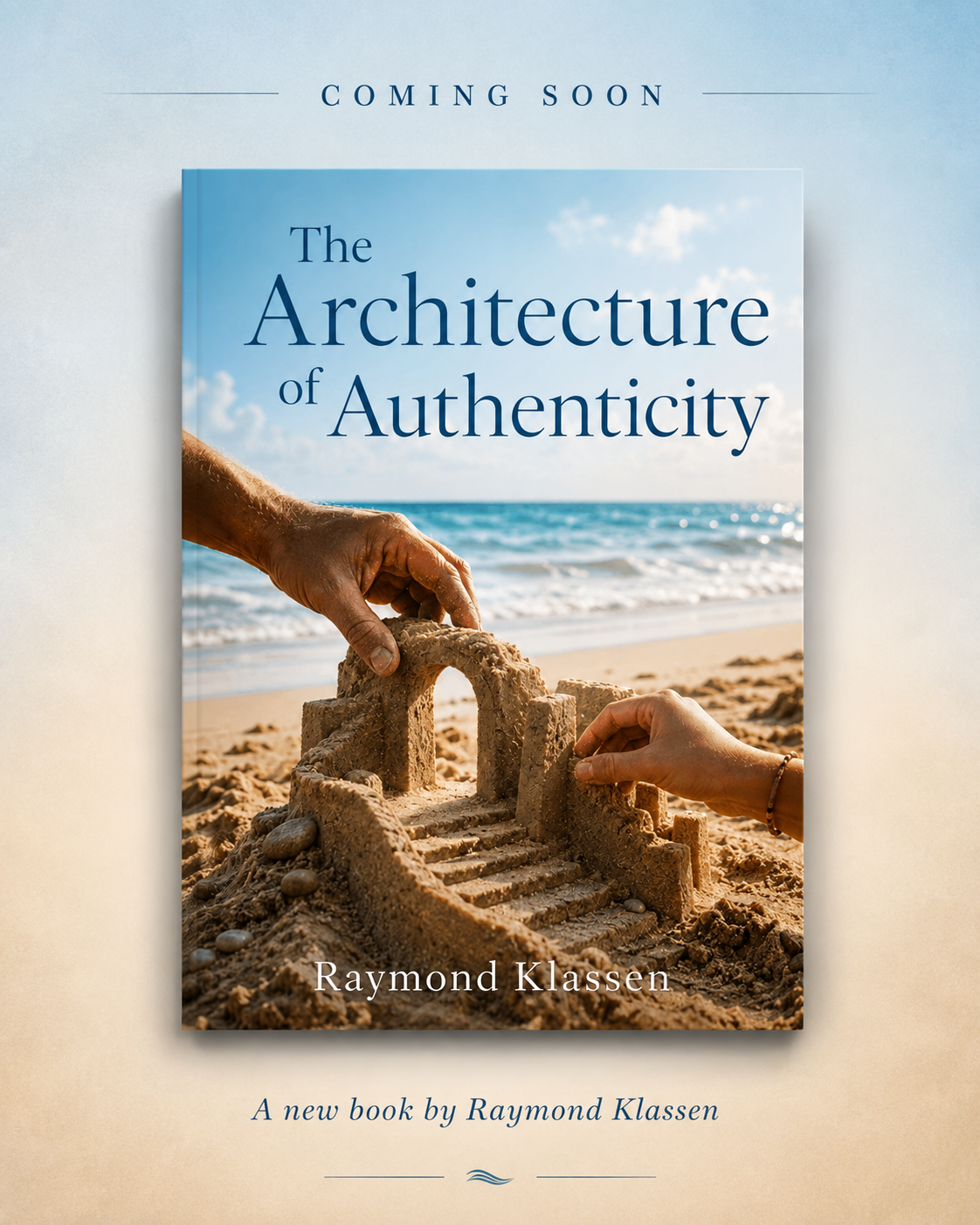
This essay is adapted from the Preface to my forthcoming book, The Architecture of Authenticity.
