

Late Comedians Invite us to the Human Condition
“If you want to tell people the truth, make them laugh; otherwise, they’ll kill you.” (Oscar Wilde)
I like making other people laugh. Sometimes it is with a question; sometimes it is with a play on words; sometimes it is in highlighting the presence of irreconcilable absurdity. I am thrilled and energized in the presence of humour, which has the power to wedge into reality – to bring us in touch with the central things that we fear and brings us into a kind of communion with each other. Comedy can help bring us together into dark and unknown places. The funny people of this world can be our guide to this place.
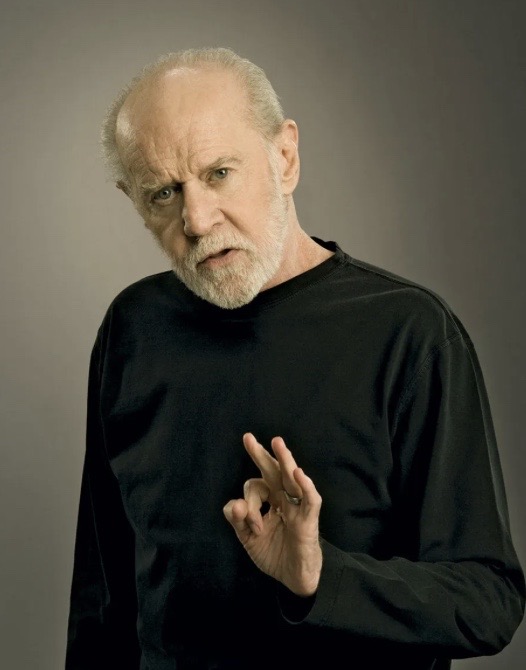
“With your comedy, do you want to make people think? Nooo! That would be the kiss of death. I want to let them know I am thinking.” With this, the late, great George Carlin offers us, among other things, a window of the essential relationship between comedians and their audience. Comedians do the work, and the audience comes to appreciate it. But the character of the comedian, in an individual performance, is left relatively untouched. Jim Carrey has famously come to this awareness. And in his talk, Carrey relays the awareness that “depression” is a signpost to the need for “deep rest.” Of course, we know of comedians who were lost to depression after not having successfully captured an audience repeatedly. But for some, like Bill Hicks and Robin Williams, depression was a documented context for their humour. Yet for others, including the ones I will highlight today, they exhibited an enduring professional interest and artistry in the craft of comedy itself. Their humour came from a place of deep rest – which is at the core of the human condition.
Now, in the following, I am going to talk about two comedians as examples of how their excellence in their art form invite us into the human condition. There are many living comedians who have my admiration, including Louis CK, Wanda Sykes, Lily Tomlin, Jim Carrey, Eddie Murphy, Hannah Gadsby and Chris Rock. But I find the best moral lessons are learned in hindsight – and these people don’t yet fit that description. I could talk about many late comedians who did this, including Robin Williams, Joan Rivers, Patrice O’Neal and Richard Pryor, to name a few. Pryor, for example, was particularly tempting because he lived and performed in such authenticity which is a topic so close to my heart. I put him aside (perhaps for another blog post) because there are plenty of examples of people exploring his life and work that, at this time, I could not include Pryor without doing him some unintentional form of injustice. However, I have chosen George Carlin and Norm MacDonald. My criteria for picking these two is that they are considered great by their peers, I found them consistently funny (say, rather than tragic), and their art explores what I consider to be essential features of the human condition and find their home in the “deep rest” of spirit. They were, importantly, professional comedians.
George Carlin
In an interview with Jon Stewart, Carlin was asked what got him into comedy. He pointed to recognition. “I wanted people to say, ‘Isn’t he cute and clever?’ And that’s all it was, was a psychic reward. You get the attention and approval of adults, and their respect. You hunger for it and keep going back for it.” Carlin was known for his authenticity, and this authentic response touches deeply the heart of the human condition – recognition. The ability to have recognition for one’s authentic person is spiritual. In that same conversation Carlin recognized that he got his gifts “genetically” – that is, from his family and his upbringing. He gave credit to his grandfather for a love of words, and for his parents who were great storytellers and had the ability to have a punchline.
Carlin inspires me because long after he had “made it” he kept working. He kept writing and performing. He worked hard at his craft. He called on himself. He balanced an innate silliness, with a sharp intelligence, a mastery of rhetorical skills, and a repulsion and rejection of illusion and injustice – especially at a mass scale. He was always arriving, but never arrived.
Carlin highlights two key features of the good life. The first is personal: he credits his success to his significant others. To be clear, significant others are those people who have a central role in one’s own identity. The centre of the real heroes of our lives is sustained and nurtured by the egoless admission that one’s character comes from these intimate places. Carlin knew it. One must preserve this intimacy – of biological-psychological reality, of parent-child, sibling, friendship, and romantic relationships – if life will remain sacred. The second feature of the good life is our relationship to the human artifice – the world into which we are born and from which we die. If there is anything to which we have never arrived and are always arriving, it is this artifice. Carlin was funny from this outsider standpoint and was able to be authentic towards the human artifice. Judy Gold said of Carlin: “He never strayed from his authentic self.”
My favorite bit from Carlin: https://www.youtube.com/watch?v=vuEQixrBKCc
Norm MacDonald
“I was on the street the other day, and I saw a garbage truck. On the back of the truck there was a sign that said, ‘Please do not follow too closely.’ Another one of life’s simple pleasures ruined by a meddling bureaucracy.” Norm honored David Letterman, whom he called a “father figure” with this joke that Letterman originally performed decades earlier. Everything that Norm MacDonald said and did about Lettermen manifested the same truth that Carlin demonstrated, that he gave credit for his own success to his significant others.
Norm MacDonald died in 2021, and grief poured across the comic world. Norm had the reputation of being the smartest guy in the room among other comics, but from the stage, he was an old school everyman. In private, MacDonald kept his truest sufferings private. He was particularly able to famously keep his struggles with cancer private. Not only was he diagnosed with cancer in the 1980s, but the eventual cause of his death, plasma cancer was diagnosed in 2013.
Norm made others laugh as a profession, but the topic of his comedy was a kind of absurdist humour. He had once told Larry King that he thought life was absurd, and that he had nothing to say. Famously, the night before the COVID lockdowns in the United States, Norm performed a comic set at the Improv in which he dug deeply into the widespread and deep anxiety over the virus. “Now we know how we will die; the only thing left is to determine is in what order.” Norm consistently explored the absurdity of the human condition. He is well-known for being a Christian, and he consistently thought of Christianity as a significant worldview that was countercultural to both the scientific worldview and to the fashionable rejection of Christianity available in mass society. But his answer was the choice of faith.
He said, “what people don’t understand about faith is that it is a choice.” Famously, Kierkegaard and Camus had responded to the absurdity of life with faith. “It is very hard to believe,” MacDonald says, but it offers us a way to deal with the absurdity. His faith, he had declared, was often inflammatory to the wider world. What Norm advocated was intuition. He thought about knowing as distinguished from what is considered facts and evidence.
He also was both horrified and fascinated with death. He acknowledged, in the above clip, that once his comedy was opened to the exploration of death, his act became mature. His real concern was to step away from cliches. Intuition was the only way to explore the depths of absurdity and death. From his fascination with Russian literature to his trust of intuition, he had learned to describe what he saw, and his comedy, was a way of talking about what is.
I am enamoured by Norm MacDonald, mostly because he was funny. But more than just being enamoured, I admire him. Why?
First, he had found his own voice, and he had used comedy to focus on issues of ultimate concern. Second, he was not afraid to choose to faith in God in the face of absurdity – and use his intuition to access it. Third, he sheltered his personal battle with cancer from public view.
Conclusion
If there is anything that helps me deal with the patent absurdity of life and death, it is faith, humour – and even comedy, and the love of significant others that form us to live with authentic intuition. To face the human artifice and life and death with humour and a refined authentic intuition amidst a backdrop of significant others is what the good life is – and it has biblical significance.


 Raymond Klassen - Ideals and Identities
Leave a reply to Ideals and Identities Cancel reply