
At the end of a two-part interview, spanning 9 days, Faith and I saw each other as good people – kindred spirits. It was an extended moment of deep recognition. Until 3 weeks ago, we didn’t know each other. She reached out to me through social media and said that my writings had renewed her hope in peace, and I think, offered her a place where she could freely be Palestinian-American. I was flattered, but to be honest, I could feel it was important that she tell her story and that as many people as possible would listen to it. She told me that she was scared to speak out. You see, she works in the finance industry in the United States, a VP Commercial Processing Manager – the marrow of the so-called “back bone” of the American economy. Expressing her solidarity with Palestinians would come at some risk, and potentially her job – and her fear is credible since a basic anti-middle eastern sentiment pervades among most of her colleagues, to the point that they have scapegoated one young man, because he is Jordanian. They even mock the majority shareholder of the bank, who is Lebanese. Although in their minds they don’t know Lebanon from Jordan. Further, she and her company serve a lot of Jewish people, and empathizing with Palestinians would most certainly be bad for business. She is intimately familiar with her relative, Rasheeda Tlaib, who was censured by the American Congress for speaking out. Tlaib partially inspired Faith to speak out, and I was lucky enough to receive her story. If I were in Faith’s situation, I would be reluctant to speak out too. Her name has been altered here to protect her identity.
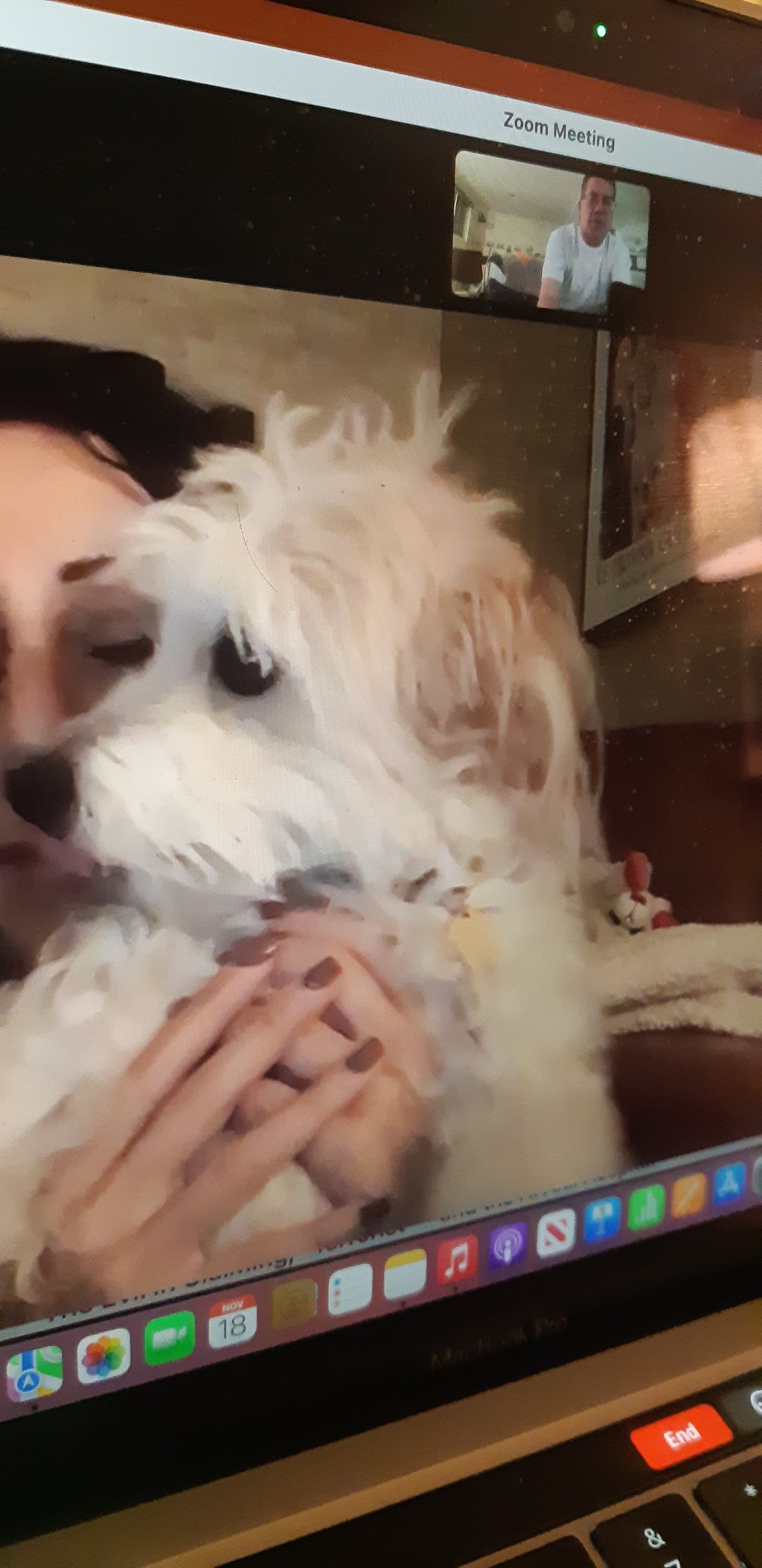
Faith is an intelligent, successful and attractive woman, with a cute lap dog hilariously named Pia (pictured above) – an acronym for “pain-in-the-ass.” She is a successful banker and non-profit volunteer, and a self-described “mom’s favorite.” Her mom, who is now elderly, still needs regular hospice care, including bathing, which Faith… faithfully… provides. Faith was born in the early-to-mid 1980’s on the American West Coast. Her birth parents are both Palestinian. Soon after she was born, her family took her back to the West Bank. She lived there until she was 5. Arabic is her first language, but you’d never know it to talk with her. Her command of English is much better than most of the native English speakers in the Alberta population I am surrounded by.
…
She went back to the West Bank for five years so that she and her siblings would be more deeply embedded into both its rich culture and the Arabic language. If you Americans are reading this, and you didn’t personally immigrate to the United States or aren’t indigenous, ask that older relative you had about how important the culture in “the old country” is. My wife (who is Thai) and I have done this with our children – bringing them back to Thailand for the very same reasons. The West Bank Faith described sounded remarkably similar to the culture of my childhood home – almost corn-fed, except one might describe its children as “olive-grown”.
Faith described her home as like living in a castle, surrounded by vast fields. She grew up near Jerusalem, in the community of Beituniya (pronounced Bitunya) which is only a few kilometers from Ramallah (closer than my nearest Amazon warehouse). She described Beituniya in the mid-1980’s as a place where people slept with their doors unlocked, where theft was unheard of, and where there were no random acts of violence. Everyone knew each other by name, and assistance to other members of the community was a matter of course, and nothing exceptional. “People would sleep on rooftops and stargaze!” Boys would play football (soccer), girls would help their moms with shopping. When people got old enough, parents would set their kids up with a few potential suitors which would frequently lead to the children choosing their own partners. Faith described the secular life she led as informed by Muslim traditions. Yet, she had friends from diverse religious backgrounds, including Christian and Jewish friends.
During her brief 5 years in the West Bank, Israel had begun occupying the West Bank in earnest. In Beitunia, a barrier had been set up to cut off the town from the lands which made up 2/3 of the district, including checkpoints and the prison in Ofer – on land confiscated from Faith’s family. It is now a torture prison. Although at the time Faith did not know what was happening, she began to have to pass an increasing number of checkpoints to do the simple act of shopping. Her older brothers would get assaulted by IDF soldiers just going to and from school. They would come home with scratches, bruises, often bloody and with broken bones. Faith and her family had the added protection of being American citizens, so their passports would offer them a pass from even worse abuse and through checkpoints more smoothly. Faith recounted that boys would be accosted and assaulted while they were on the football pitch… for no reason.
Since her mom’s house was on land that Israeli forces were intent on occupying, Faith spent more time with her grandmother. She recounted one method of occupation. If the Israeli forces wanted your home, they would surround it with police vehicles and about 10 – 20 officers. They would set up camp on top of the house and electronically survey what was happening in the house. This would often go on for days or weeks until the occupants got so uncomfortable that they would leave. They tried this on Faith and her mother. Faith recounted one day: after taking a taxi home they got dropped off down the hill from their house, since the taxi driver was too scared to go near the Israeli defense forces. They walked up the hill and the captain of the forces who had surrounded her house and camped on her roof told her mom in broken Arabic, “You are refugees! Go away!” The soldiers mocked them and laughed at them. Faith’s mother courageously laughed back at them, “No, you are the refugees! This is my home; where do you want us to go?” He replied, “I don’t care!” Faith and her mother entered their house.
Faith had seen people get shot, and lots of other “crazy stuff!”
In Faith’s most traumatic childhood event, she and her mother went shopping in Ramallah. It was during the First Intifada. After passing through 3 – 4 checkpoints, Faith and her mom arrived at the market – a place where “everyone knows everyone.” Soon into their shopping, fighting broke out and the IDF started firing rubber and plastic bullets into the market crowds – a scene Faith describes as “complete chaos.” Her mom was shot in the leg, and Faith was separated from her. Faith was in one shop, while her mom was in another nearby one. The tears started flowing down Faith’s cheeks. She gathered up the strength to continue speaking to me… she was on the ground looking at an injured, pregnant woman. Seared onto Faith’s memory, an IDF soldier was walking through the shop, stopped, and pressed the butt of his rifle into the pregnant woman’s belly and held it there for some time. Shortly after the soldier moved on, the terrified shopkeeper grabbed Faith and took her into a basement that acted as a bomb shelter. They stayed there for an hour or two until things settled down and she could be reunited with her mom. What happened to the pregnant woman? Faith didn’t know. She exclaimed in the interview, “Innocent! Unjustifiable! Done by someone we couldn’t see because his face was covered.”
Shortly after that event, her mom booked tickets, and Faith and her family returned to the United States.
…
In the United States, Faith described her early school years as infected with racism. In both elementary and early junior high years, Faith recounted that she would often be called “sand n*****” and a “Saddam-lover” or “dirty Iraqi (or Arab),” the latter of which are no doubt due to the typical American folly of conflating all Arab Middle Eastern nationalities into the particular enemy of the time – and “Iraqi” obviously used because these years were the years between the first and second American wars in Iraq. In short, the majority American public, in daily interactions, were crudely acting out an “us and them” mentality that was crude precisely because it knew nothing about “them.” Faith recounted a turning point in her childhood experience when, in the middle of her junior high school years, Faith was assaulted during lunch on a school playground. The girl who assaulted Faith was someone Faith had never interacted with before. It started with the aforementioned racial slurs, and then some repeated pushes, and then a slap. The principal was on the side of the playground observing this. Then, the perpetrator, a non-Arab, threw a punch. Faith instinctively blocked the punch and threw a straight right hand to the perpetrator’s forehead. This ended the fight.
In the aftermath, the principal called Faith’s mom to the office to discuss the matter, and Faith was, as you could imagine, very nervous because she didn’t want to disappoint her mom. However, in the meeting, without letting Faith speak, the principal misrepresented the fight, claiming that Faith had instigated it. In the end, Faith transferred to the junior high school in the next nearest district. It is not important to blame the principal for an act of injustice. Faith told this story rather nonchalantly – like it was a typical junior high fight, which so many kids have had. It was just something that happened. The worst part of it for Faith was clearly that she was disappointing her mom. Faith insisted on calling other witnesses, including friends and other kids who would not have been unduly loyal to either the perpetrator or to Faith. The principal stopped the possibility and moved on to the steps of changing schools, and as Faith believed, pushed “the problem” out of his school.
Changing schools turned out to be a blessing for Faith. Faith described her second junior high, and then high school, as a wonderful experience. Faith attributed the good experience of the remainder of her schooling to the diversity of the environment – diverse in ethnicities and backgrounds, and to a particular set of attitudes that filled the schools. Faith felt safe, and she believed that the school administration and teachers were fair. Importantly, they were open-minded and curious environments that allowed the students to be themselves. Faith became an honors student.
***
It was in professional settings that Faith experienced racism again. She described working in a predominantly African-American bank that had, what I would call, “subtle” undertones of racism toward Arab people. Later, after leaving that bank, Faith was at a time where she was nearly broke, and really needed a job, “like yesterday.” It was at this time that she was in a job interview where her Jewish interviewer asked Faith where she was from. Faith’s name was definitely Arabic, since it started with a typical “Abu” and was at the top of her resume. So, the interviewer was asking to see if Faith crossed one of the hidden job requirements of not being Arabic. A question like this is now, of course, illegal – but entirely common in the 1990s. Faith described her being put in an either / or situation by the question: if she answered truthfully, she wouldn’t have gotten the job she so desperately needed. Faith was thinking on her feet, so to speak. Faith described her attitude as a play, and she “doubled down”. Faith took the gamble by answering, “My mother, um, is Jewish, and my father is Palestinian.” She went on to explain that it is commonly understood that the Jewish faith and identity is handed down to the next generation through the mother. Faith, candidly to me, admitted she lied to get the job. And she was hired.
She described the environment of that bank as filled with “God-awful racists.” They had “the same viewpoints” perpetuating the stereotype that “if you were in the Arab world, you were just a Muslim.” She described a moment of reflection when she realized that everyone at this bank were, in her words, “entirely Jewish, and primarily Zionist… It was gross and disgusting. It got to a point where I couldn’t do it anymore.” Jokes were passed along that demeaned Arabs, and the view that was expressed about Faith was that such jokes were ok for her to hear because “she is only half Arab.”
However, there weren’t only racists. In her early working years, Faith described a Moroccan man who she worked with and developed a “trauma bond”. It was a kind of solidarity that made Faith feel like she wasn’t alone. There were also “loving people who were revealed as racists” such as a Russian woman named Maya, who loved her and, in Faith’s telling, “treated me like a daughter” and “made me mozza-ball soup.” Unfortunately, Maya later displayed what Faith called, “Netanyahu-friendly” posts on social media. The posts that were shared were not more benign comments, “like Israel had the right to defend themselves,” but were more extreme, such as “Wipe [Palestinians] off the planet,” which Faith described as genocidal. Since Faith had started to feel more strongly informed by her Palestinian identity, she “unfriended” Maya.
Later on, in her current work environment, Faith also described a manager of a different department in her bank who engaged her with an entirely different attitude. This person was, as Faith described, “curious, open to listen, interested in developing a deeper perspective, and in hearing different perspectives.” Sometime after October 7, 2023, this supervisor asked Faith, behind closed doors, “Are you ok?” And she offered space for Faith to say, “No, I’m not,” and to cry. The supervisor listened, uninterrupted, to Faith talking about her feelings and response to the events that are ongoing in Israel / Palestine. She offered Faith a “place to be.” After a couple of days, the supervisor had gone to talk with other Middle Eastern people – one who was Afghani, and one who was Jordanian – and they had described the exact same processes of humiliation and discrimination in both their homelands and in their current work environment in the United States. This director took time to learn more, to develop a deeper perspective. She told Faith her discoveries, and now Faith’s story was seen in more common terms. Faith recounted this story to me, and in the process of telling me, began to realize that this recognition, this having a space to be, is playing a huge part in her growth as a person. The supervisor did both: she offered Faith a space to be, and she took time to recognize Faith in her struggles.
***
As our interview started to wrap up, Faith became more philosophical, and we started to discuss ideas regarding Palestine / Israel. Three particularly important points came up: 1) that all those in Palestine and Israel are living and acting as being informed by trauma, 2) that mutual recognition between Palestinians and Israelis was necessary, and 3) that there are peaceful ways of responding in this situation.
Regarding the widespread trauma, Faith kept wanting to draw attention to children. I asked her why she was doing that. Faith said, “There is innocence in children.” Children in Palestine have been brutalized for decades, and it changes them in destructive and violent ways. It breeds a kind of violence that always returns back against those who perpetrate violence. She told the story of a childhood family friend named Abed, a loving, generous and playful youth. As an adolescent, he was imprisoned and beaten for between 2 to 3 years by the IDF. He changed for the worse and is now in violent opposition to what Faith called, “Israeli Occupation.”
On a very personal level, Faith also acknowledged the importance of recognition. Palestinian people are calling out for recognition which is a necessary feature of lives that matter. On this point we ventured back to the West Bank life of her youth, ‘where everyone knew each other, and people slept with their doors unlocked… stargazing.’ It was a community of the type that we all can immediately identify with, one where the deep psychological individual need of being recognized was given as part and parcel of just living; now this need for recognition has to be fought for. In Palestine / Israel (and perhaps, too, in the West), I think that recognition is missing at the deepest level, where Hamas does not recognize Israel’s right to exist, and where Netanyahu’s government does not recognize Palestinians’ indigenous existence on the land, nor permits diaspora Palestinian refugees to return to the land. Faith can go back to the West Bank for regular, three-month stints – but she is only granted that because she is an American citizen, not because she is Palestinian. She is recognized by the Israeli authorities as a tourist in her own home.
Finally, Faith and I acknowledged that there were peaceful ways to respond in the situation. Faith pointed me in the direction of a book by Miko Peled called, The General’s Son. It tells the story of Peled as a young man, a man who grew up in the Israeli military elite, and how he turned “into a fearless advocate of nonviolent struggle and equal rights for all Palestinians and Israelis.” It is an example of the spiritual-evolutionary bridge we all must cross which breaks the vicious cycle of perpetual violence. In the end, I asked Faith what she would like to tell my readers. She replied, “I want them to not look away from all the tragedies done to families and children. I hope that the world takes a pause in the violence, and in their attitudes, to reflect about why we privilege any one people.”
***
She asked me two questions: a) what horse I had in this race, and b) what I thought would happen in Israel / Palestine. To be honest, I hadn’t really put much thought into them until she asked. As to question (a) I love both Israeli and Palestinian individuals, now including Faith. But I also have been interested in question (b) for the past 30 decades of my adulthood because the Israeli-Palestinian conflict is happening between people who believe in the same God. Thus, it is not a conflict that can be blamed on God but instead resides in the human hearts of all those involved. And so, I hope we all (not only Palestinians and Israelis) see this problem as a litmus test in humanity’s desire to spiritually evolve.
Will people (and nations) be able to resolve conflict by talking to each other in good faith – honestly, openly, and risking vulnerability? Without doing this, the problems will only perpetuate. Victims will become perpetrators, and new victims will eventually turn into perpetrators. The very opposition of perpetrator and victim is beginning to lose its distinctiveness. In our violent past, Jews were violently treated and pushed on the land of Palestine – a fact Faith was quick to acknowledge. The West feels guilty about this. And this guilt keeps us in the West looking in the past. However, in the future, this is the evolutionary bridge we all need to cross, i.e., that we learn to resolve problems by talking about them rather than by using force and violence. Those that are now caught in the cycle of perpetual violence will have to interrupt the cycle. It is such a cognitively simple idea, but the courage it takes is immense. There are so many actions and processes Westerners do not want to admit. There is so much temptation to continue identifying as the victim, and to use that identity as the reason for perpetrating… When will this cycle be recognized and its vicious cycle broken? Perhaps this is the spiritual issue of our time, and we all, by virtue of being human, need to address it in our individual lives as well.
And thousands more die each day, and hostages are still being held in Gaza and in Israeli torture prisons – on land that was someone’s home. Was not King Solomon correct when he wrote: “A brother offended is more unyielding than a strong city, and quarreling is like the bars of a castle,”? (Proverbs 18:19)

 Raymond Klassen - Ideals and Identities
Leave a comment