
(For more of my commentary on The Al Aqsa Flood see my four-part coverage of the event itself: Day 1, Day 2, Day 3, Day 3 continued)
The categories we have habitually employed to understand the violence that has happened this week in Palestine/Israel have contributed to the death and destruction that we have witnessed. Understanding not only the conflict but the human condition of the range of Palestinians (in the diaspora, in Gaza, and in the West Bank and throughout Israel) correctly is a matter of life or death. At the time of writing this, approximately 1500 Israelis are dead, wounded, or have been taken hostage; for the Palestinians the numbers are more than 11,000 – this week alone.
“Crimes against humanity,” “War crimes,” and the distinction between civilians and combatants, and other ways of condemning the violence began in the international press with rockets and the incursion of Hamas over the border of Gaza into southern Israel. Now such judgments include Israeli counter attacks, the leveling of entire Gaza neighborhoods, the increasingly obvious ethnic cleansing of the Palestinian population from Gaza, and the increased violence and detentions of Palestinians in the West Bank. Claims to “barbaric acts” on both sides regarding Al Aqsa Flood hauntingly remind us of the totalitarian regimes and events of the 20th century. The world is again under the influence of the Origins of Totalitarianism (Hannah Arendt’s MOST appropriate title for a book describing the most prescient developments in our age), and totalitarianism is ironically both an increasing form of rule and the most feared; totalitarianism is the greatest temptation to politicians on both the right and the left of the political spectrum. And the world reaches for terms emerging from moral categories which are inadequate to meet the horror meted out by totalitarian regimes. What language will motivate effective intervention?
As Arendt rightfully noted, claims to human rights were meant to be a much-needed protection in our age in which individuals were no longer secure in the estates into which they were born or sure of their equality before God. In other words, in our new secularized and emancipated societies people are no longer sure of social and human rights which had previously been outside the political order and guaranteed not by government and constitution, but by community, spiritual, and religious forces. Since the nineteenth century, inalienable human rights have had to be invoked when- and wherever individuals needed protection against the new sovereignty of the state, and the new arbitrariness of society.
Since human rights have been proclaimed to be “inalienable,” i.e., irreducible to and undeducible from other rights or laws, no authority has been invoked for their establishment. “Humanity” (as in “crimes against humanity”) was their source as well as their ultimate goal. Moreover, no special law seems to be necessary to protect them because all laws were supposed to rest on them. Humanity appeared to be the only sovereign in matters of law as the people was proclaimed the only sovereign in matters of government. The people’s sovereignty (different from that of the prince) was not proclaimed by the grace of God but in the name of humanity, so that it seemed only natural that the “inalienable” rights of man would find their guarantee and become the inalienable part of the right of the people to sovereign self-government.
In other words, human beings had hardly appeared as completely isolated beings who carried their dignity within themselves without reference to some larger encompassing order, when they disappeared again into being members of a people. The declarations of human rights are shot through with the paradox that they reckoned with abstract human beings who existed nowhere, for even savages and barbarians live in some kind of social order. The only explanation for barbarians who do not enjoy human rights was obviously because, as a whole, it had not yet reached that stage of civilization, the stage of popular and national sovereignty, but was oppressed by foreign or native despots. The whole question of human rights, since the French Revolution, has been quickly and inextricably blended with the question of national emancipation; only the emancipated sovereignty of one’s own people seemed to be able to insure inalienable human rights.
This is as far as the conversation in Palestinian / Israel has gone in the international press (from Al Jazeera to the New York Times). But both the Palestinians and the Israelis know that humanity, since the French Revolution, has been conceived in the image of a family of nations. It has become self-evident that the people, and not the individual, has been the image of what it means to be human. This is what underpins all the claims to “international law.”
The full implication of this identification of human rights with the rights of peoples in the European nation-state system came to light only when a growing number of people and peoples suddenly appeared whose so-called “human rights” were as little safeguarded by the ordinary functioning of nation-states in the middle of Europe and North America as they would have been in the heart of Africa, or as we now see in Palestine / Israel. “Human Rights” were supposed to be independent of all governments; but it turns out that the moment human beings lacked their own government and had to fall back upon their minimum rights, no authority has been left to protect them and no institution is willing to guarantee them.
Stateless people, which describes every single Palestinian and not only the ones in Gaza, completely understand that the loss of national rights inevitably means the loss of human rights. The more Palestinians are excluded to right in any form, the more they look for reintegration into their own national community – a correlation that was expressed by Al Aqsa Flood. Since World War 2, not a single group of displaced persons has failed to develop a fierce, violent group consciousness and to clamour for rights as, and only as, a national group. Neither before or after the second World War have the victims of human rights violations ever invoked these fundamental rights, which have been evidently denied them, in their many attempts to find a way out of the barbed-wire prisons into which events had driven them. As one Palestinian man eloquently stated today (Oct. 14) from the Gaza side of the Rafah gate with Egypt, addressing US Secretary of State Anthony Blinken: “If we were Israelis, would the US tolerate this?” The pleas to stop the ethnic cleansing are not based on human rights, but on national rights.
The failure of all responsible people to meet the calamity of an ever-growing number of people forced to live outside the scope of all tangible law is not due to bad intentions. Human Rights (proclaimed since the French and American Revolutions) have never been a practical political issue! Since these revolutions, and even now in Palestine / Israel, human rights have been invoked in a merely perfunctory way: to defend individuals against the increasing power of the state and to mitigate the increasing social insecurity caused by the industrial, and now surveillance, revolutions. In other words, they have become a standard slogan of the protectors of the underprivileged, a kind of additional law, a right of exception necessary for those who have nothing better to fall back on.
What has become clear is that human rights, supposedly inalienable, have proved to be unenforceable, even in countries whose constitutions were based upon them – and as it is now in Palestine / Israel, this truth has become patently obvious whenever people have appeared who are no longer citizens of any sovereign state. Israel has the supposed right to defend itself, but it seems that the Palestinians don’t have rights to clean water, to food, to electricity and communications or even the rights to refuge or to medical care. No one seems able to define with any assurance what general human rights, as distinguished from citizen rights, really are. Although everyone seems to believe that the plight of the Palestinians consists precisely in their loss of human rights, no one seems to know which rights they lost and when they lost these human rights.
Palestinians now have clearly demonstrated the prophetic words of the diasporic Jew Hannah Arendt’s from 1951’s Origins, located in the chapter, “The Perplexities of the Rights of Man”:
“The first loss which the rightless suffered was the loss of their homes, and this meant the loss of the entire social texture into which they were born and in which they established for themselves a distinct place in the world. This calamity is far from unprecedented; in the long memory of history, forced migrations of individuals and whole groups of people for political and economic reasons look like everyday occurrences. What is unprecedented is not the loss of a home but the impossibility of finding a new one. Suddenly, there was no place on earth where migrants could go without the severest restrictions, no territory where they could find a new community of their own. This, moreover, had next to nothing to do with any material problem of overpopulation; it was a problem not of space but of political organization. Nobody had been aware that humanity… considered under the image of a family of nations, had reached the stage where whoever was thrown out of one of these tightly organized closed communities found himself thrown out of the family of nations altogether.
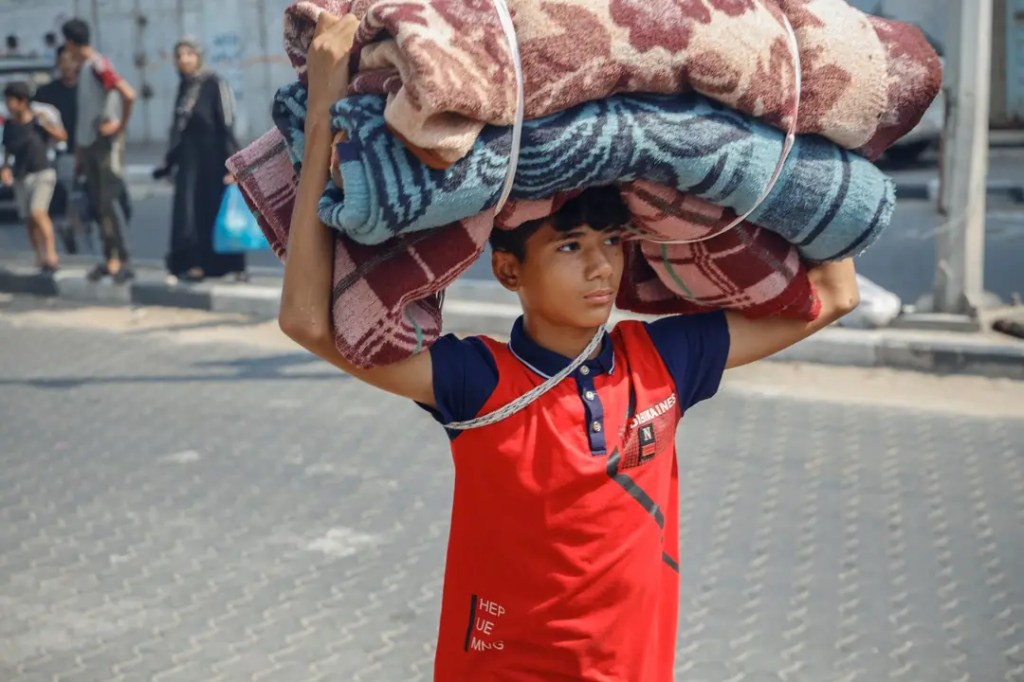
[Klassen addition: the evacuation order of Palestinians in Gaza is a perfect example of this initial loss of home, and the Israeli occupation of the West Bank exemplifies this first loss. Many Palestinians in the West Bank recognize this first step in ethnic cleansing and are resisting where they are – in their homes – even to the point of dying on their land. Further, the forced migrations of Palestinians in Gaza toward the Rafah border crossing with Egypt highlights the lack of political organization with Egypt in the Sanai Peninsula.]
The second loss which the rightless suffered [Arendt is here referring to the Jews in the months and years leading up to the Holocaust] was the loss of government protection, and this did not imply just the loss of legal status in their own, but in all countries. Treaties of reciprocity and international agreements have woven a web around the earth that makes it possible for the citizen of every country to take his legal status no matter where he goes (so that, for instance, a German citizen under the Nazi regime might not be able to enter into a mixed marriage abroad because of the Nuremberg laws). Yet, whoever is no longer caught in [government protection] finds himself out of legality whatsoever.
Arendt, Hannah. “Perplexities of the Rights of Man”, pp.34 & 35, in The Portable Hannah Arendt.
We must acknowledge that, by being Palestinian, individuals are now in a state of being expelled from the very category of “legality.” A dual Israeli American citizen has the right to flee; dual Palestinian-Americans do not.
By itself the loss of government protection is as common as the loss of a home. “Civilized countries” have offered the right of asylum to those who, for political reasons, have been persecuted by their governments. This practice functioned well enough through the nineteenth and early twentieth century, though it was never officially incorporated into any constitution. My socio-historical community of Mennonites, for example, received this in Canada when they were expelled by the Bolsheviks from the Soviet Union at the end of World War 1. However, the trouble that has arisen since the Holocaust has been that the new categories of persecuted were far too numerous to be handled by an unofficial practice designed for exceptional cases. Importantly, the right of asylum implicitly presupposes political or religious convictions which are not outlawed in the country of refuge. The new refugees of totalitarian forced migrations, occupations, and ethnic cleansing operations were being persecuted not because of what they had done or thought, but because of what they unchangeably were – born into the wrong kind of race or wrong kind of class. Let us remember the mental gymnastics we are forced into when we try to apply the completely ineffectual distinction between Hamas and Palestinians in Gaza. Israel and the US, among others, have tried to say that Hamas does not represent the Palestinians; Hamas is supposedly evil, and the civilians of Gaza are innocent.
As I conclude this first part, I want to remind those who would object to the last point with: “But Hamas started this with a barbarous invasion!” with: the forced migration of the Palestinians in Gaza had already begun with the first two stages of totalitarian domination: the loss of home and the loss of government protection. According to the now outdated and politically ineffectual language of human rights, they truly did commit, and are committing abuses. But this category of being under the legal requirements of human rights presupposes that they possessed legality itself. It is the human rights supported conventions of distinguishing both culpability and innocence, and of civilian and combatant, that Palestinians find themself excluded from at this moment.
If we are to bring the end to the Palestinian / Israel conflict, we are necessarily going to have to bring the entire Palestinian population back into the state of legality – not into a family of nations nor with pointless and virtue-signalling categories of human rights, but with a reconsideration again of what it means to be human. Only then will we be able to describe the attacks committed by both Hamas and Israel as within the realm of human capabilities and cease to use the rhetorically inflammatory language of “barbaric” and “civilized.” Only then will we be able to legitimately resist the ethnic cleansing that is now underway.
Part 2……

 Raymond Klassen - Ideals and Identities
Leave a comment