
What amazes me about life is that I have been thrown into it. I never chose to be alive. I was born into a family with 7 older siblings. I got a love of travelling from my mother. I acquired teaching skills from my father. They weren’t really choices: life, travelling, teaching … all thrown at me.
I have always experienced my mother as hot-tempered. I never realized that this modeled for me a “desireable-type”; my wife is also hot-tempered. Unreflectively, I seemed to prefer hot-tempered women.
In the twentieth century, certain existentialist philosophers and theologians thought that everything was chosen.
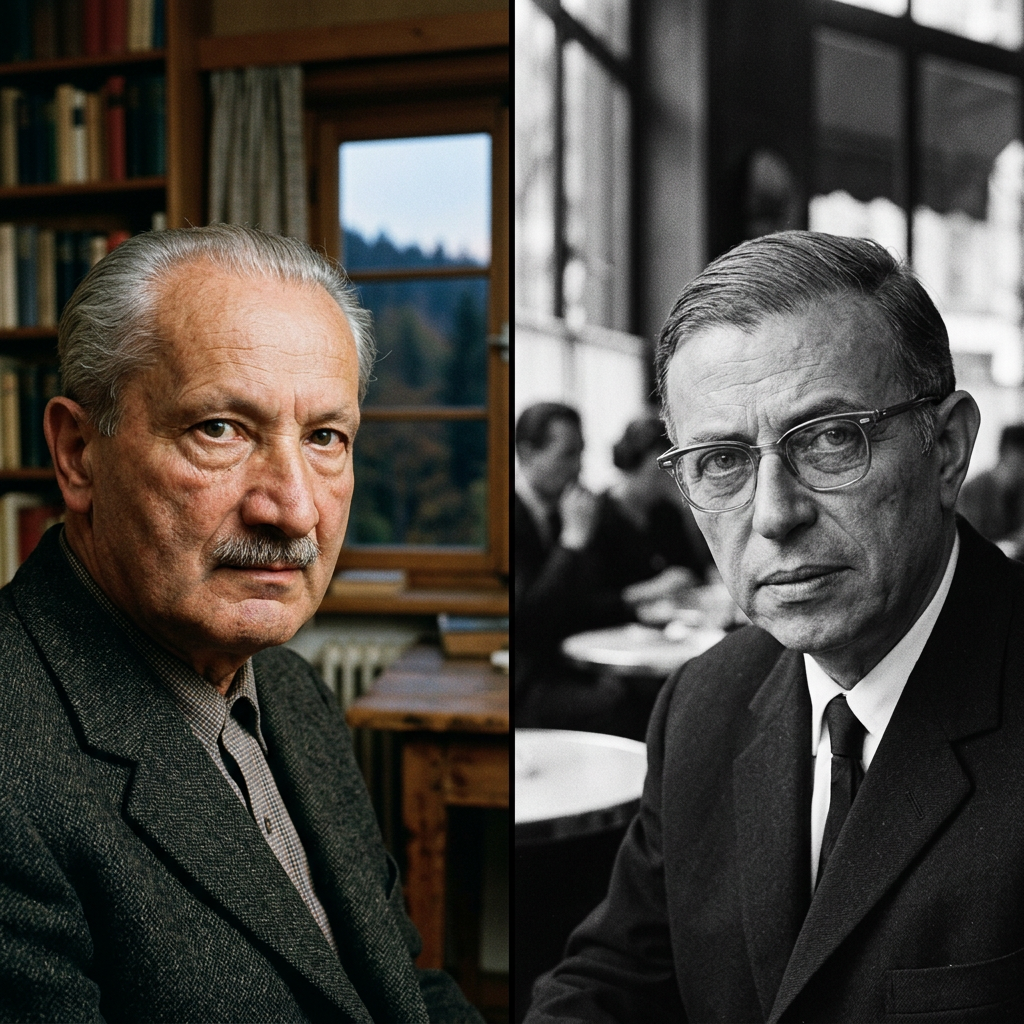
Jean-Paul Sartre admired Martin Heidegger. This is not difficult to see. Both thinkers wrote about existence, authenticity, freedom, and the human being’s strange responsibility for a life that cannot simply be handed over to custom, convention, or inherited definition. Sartre’s great work, Being and Nothingness, even echoes Heidegger’s Being and Time in its title. There is no serious way to read Sartre without noticing Heidegger’s shadow.
And yet the resemblance is misleading.
When Sartre wrote Existentialism Is a Humanism in 1946, he placed Heidegger among the existentialists. For Sartre, this made sense. Heidegger had written about human existence, anxiety, death, authenticity, and the refusal to lose oneself in the anonymous crowd. But Heidegger resisted the classification. His response came in Letter on Humanism, where he made clear that Sartre had not extended his philosophy so much as misunderstood it. Sartre had taken Heidegger’s language of existence and authenticity and drawn it back into the very metaphysics Heidegger was trying to overcome.
At the center of the disagreement is Sartre’s famous claim that existence precedes essence. Human beings, he argues, are not like knives, hammers, or tools. A knife is made according to a concept. Its essence precedes its existence because it is created for a purpose already imagined in advance. The human being is different. We first exist, and only afterward do we define ourselves through choice and action. There is no fixed human nature waiting underneath us. There is no divine blueprint, no predetermined essence, no prior design. We are thrown into existence and must decide what we will become.
This is why Sartre’s freedom is so demanding. We are not merely free in the sense that we may choose among options. We are responsible for the meaning of our lives. We cannot hide behind nature, tradition, God, psychology, or social expectation. To be human is to be condemned to freedom. The self is not discovered but made.
There is something exhilarating in this claim. It names a genuine human experience. Many people know what it means to feel trapped by inherited scripts, family expectations, social roles, religious formulas, or institutional demands. Sartre gives powerful language to the refusal to be reduced to any of these. He insists that the human person is not simply a thing with a function. We are not exhausted by our biography, our social class, our job, our history, or the categories others impose upon us. We are responsible for what we do with what has been given.
But Heidegger’s objection cuts deeper than a disagreement about freedom. Sartre says that the human being creates meaning, but Heidegger asks whether such creation is even possible. To create meaning, one would have to stand outside meaning, as though the self were a pure subject looking out upon a neutral world. But we never stand outside the world in this way. We always find ourselves already within language, history, culture, practice, memory, and concern. We think with words we did not invent. We inherit distinctions we did not choose. We discover ourselves within a world that already matters before we decide what it means.
Even the act of choosing assumes a field of meaning. To choose one thing rather than another, we must already understand difference, value, possibility, importance, and consequence. We must already have some sense that one path is better, worse, truer, more faithful, more cowardly, more evasive, more generous, or more destructive than another. Choice does not arise from nothing. It arises within an intelligible world.
This is the circularity Sartre does not adequately face. We may say that we create meaning through choice, but choice itself already depends upon meaning. We do not first stand outside the world and then assign value to it. We are always already involved in a world that has shown itself to us in certain ways. This is what Heidegger’s hermeneutic circle helps us see. We understand parts through wholes, and wholes through parts. We understand a sentence through the language in which it appears, but we also come to understand the language more deeply through the sentence. We understand an action through a life, and a life through its actions. We cannot escape this circle because it is not a mistake in reasoning. It is the structure of understanding itself.
This changes the meaning of authenticity.
For Sartre, authenticity is bound up with self-creation. The authentic person accepts the burden of freedom and refuses bad faith. They do not pretend that their choices are dictated by some fixed essence or external authority. They own their freedom and act. But for Heidegger, authenticity is not primarily self-creation. It is a more truthful way of being disclosed within the world. It is not the invention of meaning, but a more attentive participation in the clearing where meaning appears.
The metaphor of poetry helps here. A great poem does not feel as though the poet simply manufactured something from nothing. It feels as though something hidden in the world has been brought into speech. The poet does not impose meaning on reality like a label pasted onto an object. The poet receives, attends, listens, and discloses. The poem reveals something we somehow recognize, even if we had not seen it clearly before.
For Heidegger, human existence works something like this. The human being is not an isolated subject standing over against an isolated object. That subject-object division is precisely what Heidegger wants to unsettle. We are not minds trapped inside ourselves, projecting meaning outward onto a meaningless world. We are beings-in-the-world. We are already involved, already addressed, already claimed by what appears.
This is why Heidegger’s question is not, “Who creates meaning?” That question already assumes too much. It assumes a creator standing apart from meaning and a world waiting passively to receive it. Heidegger asks a more fundamental question: what makes it possible for anything to appear as meaningful at all?
His answer is the openness of Being, the clearing in which things can appear. Human beings do not create this clearing, but we belong to it. We are the place where Being can be disclosed, the opening through which the world becomes intelligible. Heidegger famously says that the human being is the shepherd of Being. This is a strange phrase, but its strangeness is useful. A shepherd does not create the flock. A shepherd receives responsibility for what has been entrusted. The shepherd watches, protects, attends, and preserves.
This gives us a very different picture of responsibility. Sartre’s human being is responsible because the human being creates meaning. Heidegger’s human being is responsible because meaning is disclosed through us, and we may either attend to that disclosure or obscure it. Responsibility is not the burden of inventing reality. It is the burden of receiving reality truthfully.
This distinction matters because modern life often pushes us toward Sartre’s temptation without giving us Sartre’s courage. We are constantly told to create ourselves, define ourselves, brand ourselves, optimize ourselves, and perform ourselves. Meaning becomes a project of self-production. Identity becomes a design problem. Freedom becomes the endless obligation to curate a self that appears meaningful to others.
But this kind of self-creation easily becomes exhausting. If I am the source of meaning, then I must constantly generate the significance of my own life. I must turn experience into identity, attention into visibility, desire into personal brand, and suffering into usable content. The self becomes both artist and product, creator and advertisement. The promise is freedom, but the result is often fragility. A self that must create all meaning for itself is never finally at rest.
Heidegger offers a different possibility. The human being is not the sovereign author of meaning, but neither is the human being meaningless. We are not passive objects in a mechanical universe. We are the site where the world can appear, where truth can be received, where things can matter. Our dignity does not lie in our power to impose meaning, but in our capacity to disclose it.
This has profound implications for authenticity. Authenticity is not simply the assertion of the self against the world. It is not the heroic declaration that I alone will decide who I am. It is a truthful form of attention. It is the willingness to let reality address me before I convert it into a project of self-expression. It is the discipline of receiving what is given, discerning what is entrusted, and responding without reducing everything to preference, performance, or control.
This is where Heidegger’s critique of modernity becomes especially important. Modernity often teaches us to approach the world as material for use. Nature becomes resource. Technology becomes mastery. Other people become instruments of recognition, productivity, or desire. Even the self becomes a project to be managed. In such a world, the human being forgets the role of shepherd and becomes instead a producer, controller, and consumer of meaning.
But a life of authenticity requires more than production. It requires preservation. It requires silence, attention, gratitude, and care. It requires the humility to admit that meaning is not simply whatever I decide it is. There are realities that call to us before we choose them. There are obligations we discover rather than invent. There are truths that arrive not as possessions, but as summons.
This does not mean Sartre is simply wrong. His insistence on responsibility remains necessary. Human beings do evade freedom. We do hide behind roles, institutions, habits, and excuses. We do pretend that our lives are more determined than they are because responsibility frightens us. Sartre gives us a language for refusing that evasion.
But Heidegger helps us see that freedom is not enough if it is severed from receptivity. The self cannot become authentic merely by choosing more intensely. Choice itself must be formed by attention to what is real. Otherwise freedom becomes another form of mastery, and authenticity becomes another name for self-invention.
The deeper question is not whether I create myself or receive myself. It is whether I can become truthful within the world that has already received me. I do not begin as a blank slate. I begin as someone addressed by language, history, place, body, mortality, love, loss, and the claims of others. My task is not to invent meaning from nothing, but to respond faithfully to the meaning that becomes visible in and through my life.
Perhaps this is why Heidegger was so resistant to being called an existentialist. Sartre reversed the old formula. Where traditional metaphysics said essence precedes existence, Sartre said existence precedes essence. But for Heidegger, the problem was not merely the order of the terms. The problem was the framework itself. To keep arguing about whether essence or existence comes first is to remain inside the same room, merely rearranging the furniture.
Heidegger wanted to ask a more original question. Not what is the human being as an object? Not how does the subject create meaning? But how does the human being stand in the clearing where Being is disclosed? How does the world become meaningful at all? And what kind of life is required if we are to preserve that openness rather than close it down through control, distraction, or self-assertion?
This question remains urgent. We live in an age that encourages constant self-definition, but often leaves us estranged from reality. We are told to express ourselves before we have learned to listen. We are told to construct identity before we have learned to receive a world. We are told to create meaning, but not to ask whether meaning might first have to be disclosed.
The human being is not the source of meaning. That is too heavy a burden and too small a vision. The human being is the place where meaning may appear, be received, be guarded, and be lived. Authenticity begins not when I declare myself sovereign, but when I become capable of truthfulness.
And perhaps this is the real difference between Sartre and Heidegger. Sartre teaches us that we are responsible for our freedom. Heidegger teaches us that we are responsible for our attention. Sartre warns us against bad faith. Heidegger warns us against forgetfulness. Sartre tells us we must choose. Heidegger asks whether we have first learned how to see.
The modern self does not need another command to invent itself. It needs a deeper invitation to receive reality without immediately turning it into a mirror. It needs to become less like a manufacturer of meaning and more like a window through which the light may enter.
