
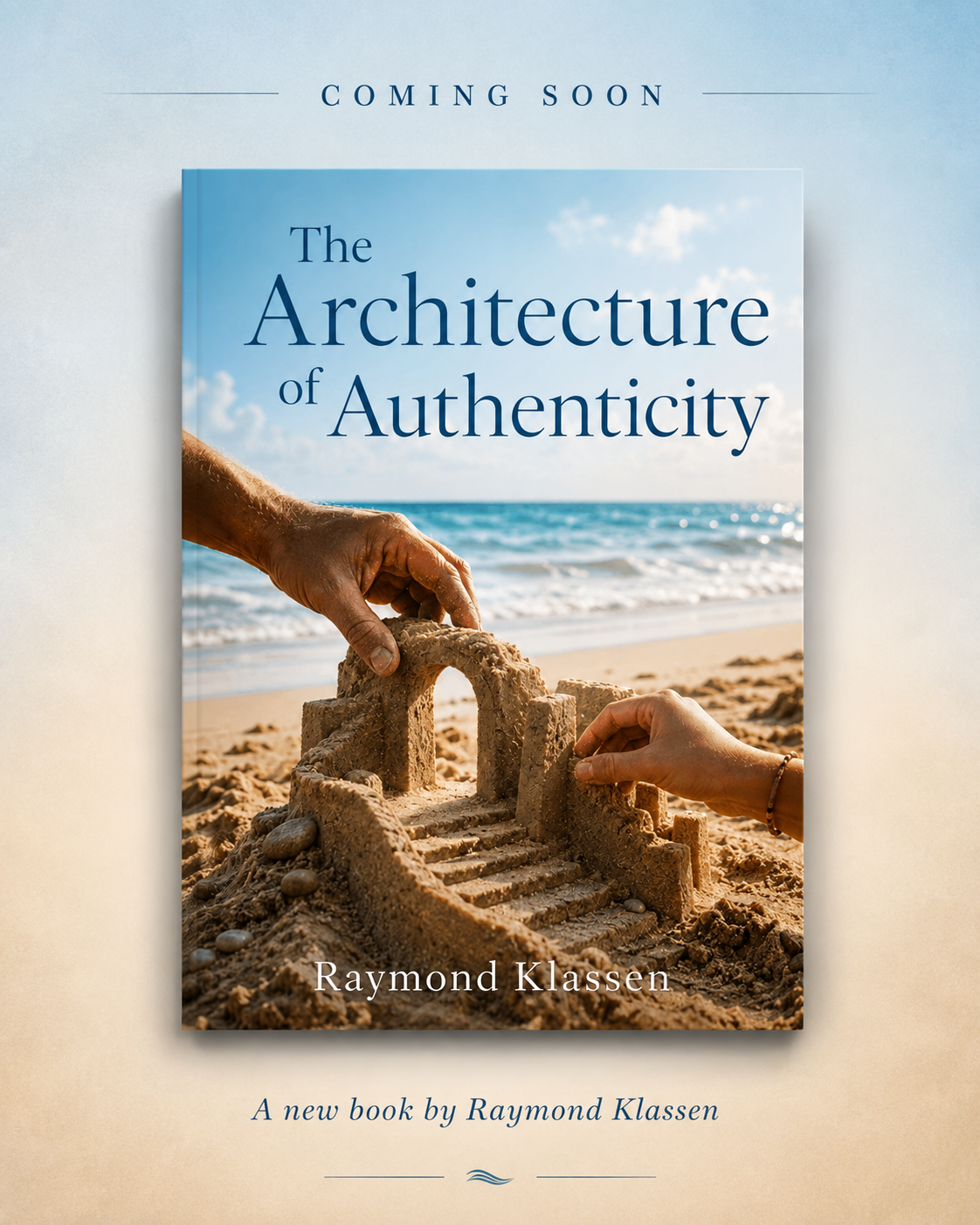
A Book Leaves the Desk
There is a strange moment in writing when the work stops belonging entirely to the writer.
For a long time, The Architecture of Authenticity existed as notes, arguments, stories, conversations, abandoned paragraphs, rewritten chapters, and pages I kept returning to because they still did not quite say what I wanted them to say.
This week, something changed.
The Architecture of Authenticity is now available for pre-order on Amazon.
That sentence feels surprisingly difficult to write.
The book began with a question that has followed me for much of my life:
How can a life become genuinely our own when so much of who we are has been given to us?
We inherit families, languages, cultures, faiths, histories, communities, responsibilities, wounds, and possibilities. We do not create ourselves from nothing. Yet somehow we must still become people capable of answering for the lives we live.
Over time, that tension became the architecture of the book.
It moves through private, social, political, and spiritual life, asking what authenticity might mean if it is something more demanding than simply “being yourself.” I came to understand authenticity instead as a lifelong practice of truthfulness: learning to inhabit what we have received while remaining open to correction, relationship, transformation, and grace.
One sentence near the beginning of the book has come to feel like its doorway:
We can spend a lifetime building a life we never learn to inhabit.
Perhaps writing this book has been part of my own attempt to learn how.
The Architecture of Authenticity is coming this October
The Kindle edition is now available for pre-order on Amazon, with the full publication planned for October.
The book sees philosophy manifesting in ordinary life: family, work, education, community, politics, technology, faith, belonging, disappointment, and the difficult work of becoming someone capable of truthful action.
It draws on thinkers such as Charles Taylor, Hannah Arendt, Paul Ricoeur, Thomas Merton, Simone Weil, Søren Kierkegaard, and others, alongside insights from multiple faith traditions and experiences from my own life in Canada and abroad. But I have tried throughout to keep the philosophical questions close to lived experience.
One early reader, philosopher Dr. Joshua Harris, described the book as:
“a heartfully reflective, rigorously attentive encouragement to reading wayfarers of modern life.”
Another reader wrote:
“It gave me words for lessons I had learned unconsciously. Now the architecture is set. And I feel relief.”
Those responses mean a great deal to me because that is what I hope the book can do: give language to questions many of us are already living.
[Pre-order The Architecture of Authenticity on Amazon] While it is on pre-order status, the cost is only $7.99 (US). After the release date, the price will go up to $9.99 (US).
Worth Reading
One conviction became stronger as I wrote this book: authenticity cannot mean becoming independent of everyone and everything that has formed us.
Charles Taylor helped me see why. We become ourselves within languages, histories, relationships, and communities that existed before us. The real question is therefore not simply, How do I escape influence?
It is:
What kinds of formation help us become capable of judging the very things that formed us?
That question now seems especially urgent in education, politics, religion, and in a world increasingly shaped by artificial intelligence.
From the Archive
An earlier essay, “Two Meanings of Sovereignty,” explores an idea that eventually became important in the political section of the book.
Sovereignty can mean responsible agency: the capacity to act, govern ourselves, and accept responsibility for what follows.
But it can also become a fantasy of mastery: the desire to be answerable to no one and dependent upon nothing.
That distinction matters for individuals, communities, and nations alike.
[Read “Two Meanings of Sovereignty”]
What I’m Working On
The work now feels different.
For months, the central question was: Is the book finished? Now the question is becoming: How does it find its readers?
I am beginning to work on the Amazon author page, podcast outreach, reviews, conversations with readers, and the wider launch of the book. I am discovering that publishing requires a different kind of vulnerability than writing. Writing allows a book to remain quietly on the desk. Publishing asks you to let it leave.
I hope it finds people who have built lives that work and yet sometimes wonder whether they fully inhabit them.
A Good Question
I will leave you with a question that sits underneath much of The Architecture of Authenticity:
What in your life have you genuinely chosen—and what have you received that you are now responsible for making your own?
Perhaps authenticity begins somewhere in the space between those two things.
Thank you for reading—and especially to those of you who have encouraged this project while it was still becoming a book.
Raymond Klassen
Ideals and Identities
