

In a shopping mall in China, I found myself looking upward through a vast, bright atrium. Floor after floor curved around the open space, each balcony repeating the clean lines of the one below it. Long advertisements descended through the centre. The largest human faces in view were not those of the shoppers but those on the banners: carefully composed images of beauty and refinement, accompanied by the unmistakable name Lancôme. The building seemed to have its own grammar. Even before I entered a shop, I understood something about the kind of experience being offered.
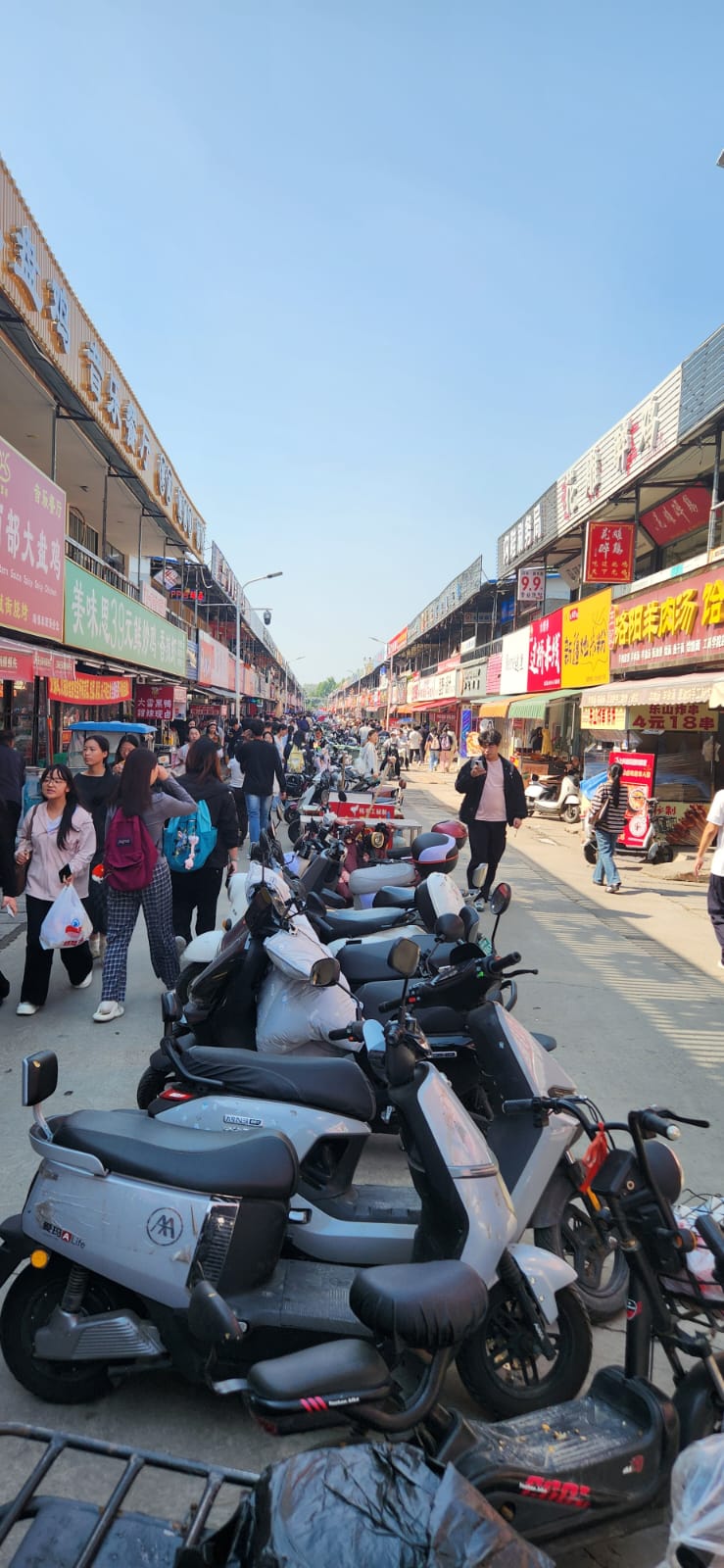
In another Chinese city, I photographed a very different commercial street. Shopfronts stood close together beneath large, competing signs. Scooters occupied the edges of the road, sometimes seeming to claim as much space as the pedestrians. People moved among stalls and storefronts with the determined flexibility that a crowded street requires. Here, the scene resisted a single perspective. My eye kept returning to the people threading their way through it.
The temptation is to describe the photographs as two Chinas: the older world of the market and the newer world of the luxury mall. There is even a traditional market near the mall I photographed. Yet the proximity of these places makes that simple story difficult to sustain. If both belong to the same city and the same present, why am I so quick to treat one as the past and the other as the future?
The story we bring with us
Western discussions of China often begin with the state, international competition, economic power, or the extraordinary pace of technological development. These are important subjects. Yet an ordinary shopping street may disclose a different set of questions, especially when it sits beside an environment that would look familiar in Toronto, Paris, or Seoul. The two places invite us to examine what modernity is supposed to look like, and who taught us to recognize it that way.
We have inherited a story in which social development seems to move in one direction: from personal encounters to impersonal institutions, from locally rooted practices to global systems, from the crowded and unpredictable street to the managed and polished interior. Once this story becomes familiar, the mall appears to represent arrival, while the market looks like something that has survived. The narrative supplies the interpretation before we have really looked.
But there is nothing simply premodern about the street in my photograph. Its electric scooters, commercial signage, and networks of supply belong to contemporary China. A vendor may depend on mobile payment platforms as readily as a luxury retailer does. Equally, nothing about the shopping mall prevents friends from meeting there, families from spending time together, or a worker from becoming known to regular customers. The contrast is real, but it cannot bear the weight of a moral division between genuine community and artificial consumption.
How a place teaches us to participate
Every public place teaches us, often silently, how to behave. We learn whether conversation is expected, whether we may linger without buying anything, how much personal space to claim, and how strangers ought to acknowledge one another. We seldom think about these lessons because they arrive as ordinary expectations. Yet they influence what kinds of encounters become easy and which ones feel awkward.
The shopping mall is particularly explicit in its design. Its levels, sightlines, displays, and brands offer cues about movement and aspiration. The advertisements do not merely say that perfume is available. They associate consumption with images of a desirable self. One learns where to look and, perhaps, something of how one is invited to imagine one’s own place in this environment. Still, a space designed for consumption can become a setting for relationships that exceed its commercial purposes.
The market presents a less unified visual order. The shop signs compete; the movement of pedestrians must accommodate parked vehicles, other shoppers, and changing circumstances. Buying something may involve an immediate encounter with the person selling it. The visibility of labour is harder to avoid. But familiarity can also produce its own exclusions, and the crowded vitality of a market tells us little by itself about the burdens carried by those who work there. Neither photograph can tell us whether its participants feel respected, free, or at home. It can only prompt us to ask better questions.
The social imaginary beneath the surface
In an earlier essay, ‘Social Imaginaries,’ I drew on the Canadian philosopher Charles Taylor to explore the shared understandings through which people imagine their life together. A social imaginary is more than a formal account of how society should function. It includes the largely unspoken expectations that make everyday cooperation possible: how people fit together, what they may expect from others, and which ways of living appear normal or admirable. These understandings are also normative. They carry ideas about what is good, respectable, and worth pursuing.
Seen this way, the mall and the market do more than arrange transactions. They offer overlapping ways of imagining social participation. The mall makes a globally recognizable language of brands, presentation, and consumer aspiration available within a Chinese setting. The market offers forms of commercial life in which the particularity of the street, the seller, and the surrounding neighbourhood remains more visible. People may move easily between these worlds without thinking they have crossed between tradition and modernity. They have simply moved through their city.
This is where the notion of systemic life becomes useful. By systemic life, I mean the ordinary experience of living within networks of infrastructure, rules, habits, and expectations that organize our possibilities before we explicitly choose them. Such systems are indispensable. The market depends on roads, distribution, currency, regulation, and increasingly digital platforms; the mall depends on comparable arrangements in a more visibly coordinated form. The important distinction is therefore not whether a place contains systems. It is how those systems, together with the imaginaries that sustain them, teach us to recognize ourselves and one another.
A system may make a transaction possible. A social imaginary helps make the encounter intelligible: who counts as a customer, what counts as success, which gestures signal respect, and what a person is entitled to expect. The two continually shape each other. Institutions embody shared understandings, while our repeated participation in them makes those understandings feel natural. We may come to inhabit an idea of the good life without ever having consciously agreed to it.
The Western observer is also inside the picture
The most uncomfortable part of this reflection concerns my own position as a Western visitor. I can enter the luxury mall and recognize its aesthetic even when I cannot read every sign. The brands, displays, and aspirations seem to speak an international language. That familiarity can seduce me into imagining I understand the place more fully than I do. Meanwhile, the market may seem more culturally distant precisely because it does not organize its invitations around forms of consumption I already know.
It would be a mistake to confuse my familiarity with universality. A global brand can be locally interpreted, bought for reasons I do not know, or placed within obligations of family and friendship that its advertising never mentions. The ostensibly cosmopolitan mall can also reproduce strong distinctions of income and status. Its international character does not guarantee a more generous social world. Nor does the market’s local texture guarantee solidarity. The lives being conducted in these places are richer than the categories I initially bring to them.
In my earlier writing about social imaginaries, I considered the tension between cosmopolitan openness and rooted, sometimes tribal attachments. Cosmopolitanism promises an enlarged horizon of belonging, yet it can become the sensibility of people who share education, mobility, money, and cultural confidence. Local attachments may cultivate loyalty and mutual responsibility, even as they can also mark outsiders as strangers. What matters here is the tension itself. A city must somehow accommodate people whose ways of finding meaning, recognition, and belonging do not neatly coincide.
This brings us to the hinge in the story. My first instinct was to look at the two photographs and imagine China’s journey from an older social order into a newer one. The more interesting possibility is that the judgment reveals the social imaginary through which I am looking. I had assumed that the forms most legible to my Western experience represented the destination of development. The city was showing me coexistence; I had imposed succession.
More than one way to inhabit the present
A person can purchase breakfast from a small vendor, pay for a train ticket on a smartphone, work in a highly organized institution, and meet friends in a shopping mall, all within an ordinary day. These experiences do not require that person to choose between two centuries or two civilizations. They are part of a single contemporary life, although they may invite different expectations about courtesy, status, freedom, and relationship.
The question that now interests me is what happens when we allow these different forms of life to be seen on their own terms. Modernity need not appear as one uniform culture gradually sweeping away everything particular. Nor should the visible persistence of older practices be mistaken for evidence that people are untouched by modern systems. The city is a place where people inhabit, modify, and sometimes contest multiple social imaginaries at once. Its inhabitants may be considerably more practiced at negotiating that complexity than the visitor trying to classify what he sees.
I do not want to turn two photographs into a theory of China. They cannot establish what shoppers or vendors think, or settle questions about freedom, class, or political life. They can, however, make a familiar habit of interpretation visible. When I look again at the high banners in the mall and the crowded shopping street in the other photograph, I am less confident that I know which one tells the story of tomorrow. Perhaps that confidence was always part of the story I brought with me.
I began by asking what a traditional market and a luxury shopping mall have in common. Both are places of exchange, certainly, and both belong to the systems of contemporary China. But they also belong to the imaginative life through which people learn what to expect from a shared world. The deeper question may be whether we can recognize different ways of belonging in the same present, without first arranging them into a hierarchy of progress. That challenge belongs to Western societies no less than to China.
