
I remember a question my parents (especially my dad) had to answer that I used to feel that I had to answer. They are part of what has been called “the great generation,” i.e., the generation before the boomer generation.
“How are you living with your partner that empowers the freedom of the woman in your relationship?” This was the question of the boomer age, and my boomer siblings had put this question to my parents. But now, I feel no need to address this question. What I have come to realize is that this question has transformed from a demand to prove liberation into a deeper question about authenticity and agency.
—
I grew up in southwestern Manitoba, the youngest of eight educated siblings. Our family was raised as Mennonites. And my parents, each in their own way, centrally and awkwardly occupy the rooms in my mind reserved for models of admiration. My own self-image is partially formed by the ongoing conversations with them. This is true of my father, who has been dead for 22 years, and my aging mother who suffers from dementia, and from diminished sight and hearing.
My mother never finished her high school education, but is one of the most well-read people I have ever known. She was a housewife but had gone out to work when I was in pre-school. She always was a stalwart in our local church: she coordinated all social functions, and was central to any function that required food in the life of our church. In other words, she was central to the life of our family and community. She later proved herself to be a successful business person, founding the MCC Thrift shop and managing the non-profit used clothing store that raised money for the YWCA. She was a model for her female peers who rarely ventured into careers after the kids were raised. After raising 8 kids, she frequently expressed a liberation in being able to get out of the house. The career woman had recently become a new kind of hero.
My late father was a PhD in education, a university professor and a lay minister in our local church. While my mom was central in the kitchen at any church function, my father was at the pulpit. He was a leader, and he was a dyed-in-the-wool Anabaptist conservative. He believed that the most important challenges he faced were to get others to understand and be moved by the central spirit that animated the ways of life of Mennonites: commitments to peace, relational ways of making public moral judgment, the integrated economic life of the members of the community, and above all, the unity of believers in the congregation.
The way my parents were publicly understood was that my father was an exemplary leader, and my mother was his long-suffering supporter. And while I understood these personas, I knew them more viscerally. My dad guided me by asking questions of me, and seemed to encourage me constantly to be a person who had a personal relationship with God, a confessional way of speaking with the people central to my life (including my mom and my siblings), and a love for ideas. On the other hand, my mom was the kind of person to give me advice (as opposed to asking questions), and who was more likely to say, “don’t be an idiot, Ray!” She was the kind of person who had sympathy for when I broke a finger playing volleyball, but not the patience or energy to wait with me at the hospital while I got the splint for it.
I was in my teenage years in the 1980s, and the feminist revolution in our culture was at least 15 years old. Many viewed my parents the way I had described above, the perfect exemplar of a 1950s model of what a family should be. But in my teenage years, a question by the boomer generation was being put to my parents, and especially to my dad: how are you living in a way that liberates mom? I remember sitting around our dining room table with my older siblings, and hearing elder siblings grilling my father on just this point.
As disrespectful as this may seem, the point got driven home differently for my dad. He had a heart attack and stroke brought on by overwork when I was 13 years old. I spent one whole spring helping my dad recover, including feeding him, and helping him learn how to walk and speak again. For an orator like him, I am certain he experienced this as a kind of identity crisis. He was never able to work full time again, and he went on permanent disability.
At that time, my older siblings had moved away from home. My oldest four siblings were already married, and my three other siblings had moved away for school. I had a particularly intimate view of the changes that happened in my dad. The feminist question that had been posed to him about the ways he behaved that encouraged my mom’s freedom seemed to take hold of him. My mom, well on her way in her career, had enough resentment about being cooped up in the house to start a revolution. But my father was well aware of it. He became much more domesticated. He made pancakes, and relentlessly cleaned and tidied the house. Grandchildren were on the scene, and my dad threw himself headlong into caring for them – especially the four oldest. Being an only child at home, he emphasized the importance of caregiving.
Prior to his medical emergencies, he definitely defined masculinity for me, as a son, in the ability to provide for a family. Masculinity was largely defined by “providing.” After his medical emergency, this definition of masculinity changed. It broadened to more of the ability to provide care to the family, and especially to be in tune with the needs of mom, and by extension, to be a constantly improving husband.
It was his way of addressing the feminist question.
—-
My first wife and I were Generation X, and we were under the pressure to have our answer to the feminist question worked out. We compared our relationship constantly to our peers who had varying ways of answering this question. Our answers to the question had a kind of performative quality. Were we liberated enough? Did I, as a man, do enough around the house? Was my spouse doing enough “providing”?
The omnipresence of this question filtered into our relationship in pernicious ways. I overcompensated. I did all the cleaning, laundry and cooking. She was entirely career focused. We both acted this way with a mutual inferiority complex. We both approached it from a standpoint of lacking. As a man, I could never do enough to promote the freedom of my partner. As a woman, she could never do enough to provide for a family. When I look back on it, we turned ourselves into knots trying to prove things to ourselves, to each other, and to our peers that were, in reality, a pseudo-issue.
It even clouded our joint marriage counselling and individual psychotherapy sessions. It turns out that our therapists, whether from a Christian or a secular perspective, were fixated on answering the question, which was a microcosm of the larger question of what masculinity and femininity means in culture, and how that works out in partnered relationships.
The question of being authentic to who we were was obscured from both of us. God’s blessing on us was that we never had children.
—-
My second (and last) wife is not from North America, nor from “the West.” If you look at our relationship now from the frame of the feminist question you might conclude that we are straight out of the 1950s. I do the lion’s share of the provision, and she does the lion’s share of the direct caregiving. She cooks most of the time. Our broader social relationships are generated from my church and work commitments. The commitments our children have outside the house (e.g., medical, after school programs, part-time jobs) are my primary responsibility.
We are not so much out of the 50’s but a convergence of a Thai culture that envisions the good life of the women as being free to work or not work as she sees fit while at the same time not ever being completely relieved of the burdens of caregiving, and a feminist man who feels ownership of both caregiving responsibilities and provision. Inside the house, when I give too much effort toward household chores, my wife metaphorically stomps her foot down and tells me to get lost. My wife, in no uncertain terms, tells me to stop being so concerned with her freedom and just respond to her as she needs, i.e., instead of what I think she needs. She reminds me I have nothing to prove. From a purely Western perspective, one might think she doesn’t want too many cooks in the kitchen. But I know better.
She does not tolerate any cloud over the authenticity in me.
—-
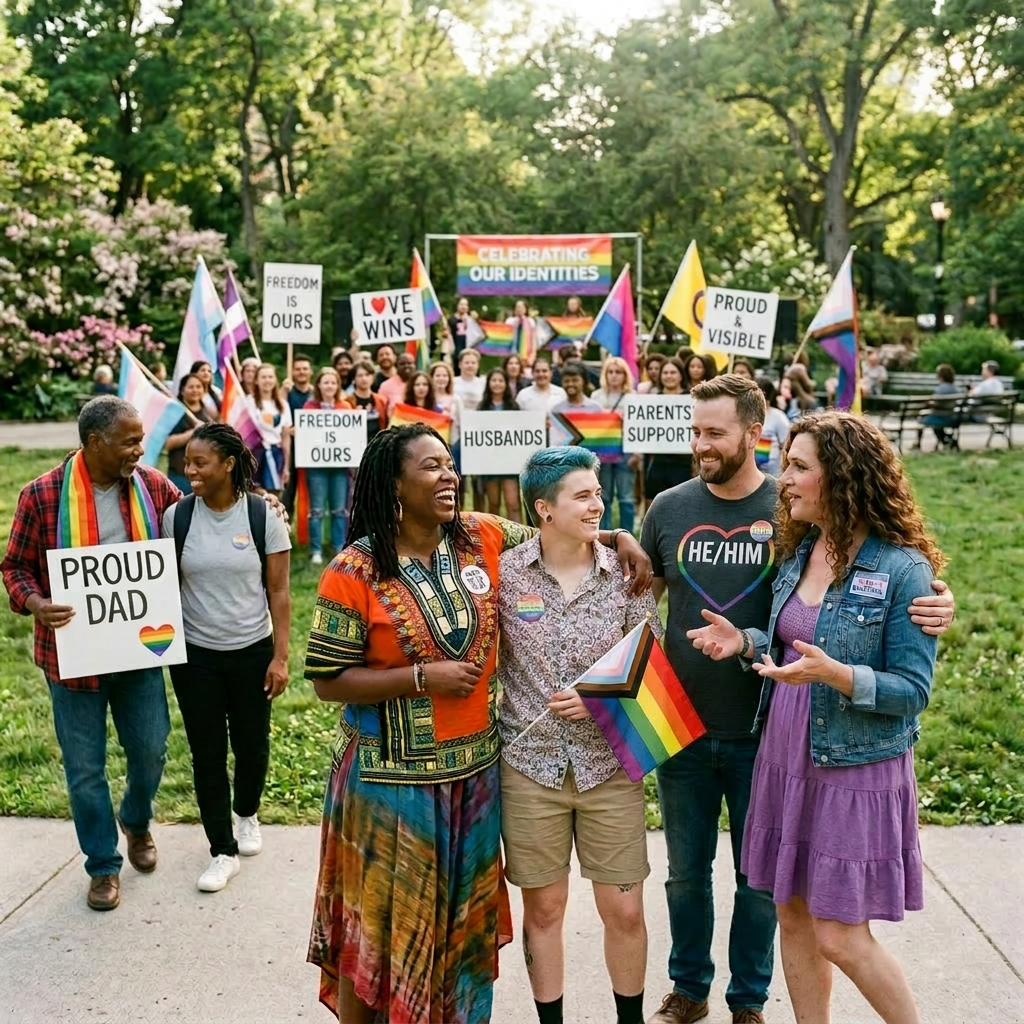
We are now faced with the publicity of queer identities. Some of us deal with this very personally: some are queer, some are changing gender, and many of us have someone in our family who are taking on masculinity and femininity head-on. The emergence of queer identity in public life is not a departure from the feminist question, but its intensification. It presses the same issue to its limit: not whether we are liberating others, but whether we can allow identities to emerge without imposing a script.
Certain communities want to suppress this reality. I don’t want to suppress the identity of the ones I know who are “abnormal.”
When I was a teenager, it became apparent that my body (for a male) was producing an abnormal amount of estrogen. Yesterday, my youngest and I purchased a bottle of testosterone. Strangely, I identified with him, even if only a little.
The question of living in a way that encourages the freedom of the significant others in our life takes on a different tone these days.
—-
I was talking with a good friend the other day. His friendship was forged in the time of the courtship and the first few years of my first marriage. Like others in that milieu he had a marriage that was plagued with a kind of performative authenticity concerning gender roles and the liberation of women. We were all working out a question about how we could encourage the respective freedom of our wives. We felt like we had to answer to a wider community and gain their approval.
But now, in our 50s, I think we both came to an understanding that we don’t have to answer that question anymore. In my case, I haven’t had to answer it in my marriage. Now, the question that drives us and frames the way we partner with others and parent our adolescent and post-adolescent kids isn’t about demonstrating anything. Instead it frames the question of freedom outside the parameter of being “cooped up in the house” as my mother had experienced it. Its impetus is whether we can, as fathers and husbands, transfer ownership, responsibility, and, well… agency to the people in our care.
Now, instead of performing our roles, we accomplish them with a certain kind of rehabilitated ability to refuse the clouding of the authenticity of ourselves and our significant others. And for that, I am glad the feminist question has evolved.

 Raymond Klassen - Ideals and Identities